
CLASS 99
The blog for design law, in Europe and worldwide. This weblog is written by a team of design experts and fans. To contribute, or join us, or for any other reason, email class99@marques.org.
Want to receive Class 99 by email?
Click here subscribe for free.
Click here subscribe for free.
Who we all are...
SUNDAY, 4 OCTOBER 2009
Good news for copyright infringers, or a Trapp to Tripp designers?
Tags: chair, copyright, damages, germany, infringement,
Perm-A-Link: https://www.marques.org/blogs/class99?XID=BHA62
Good news for copyright infringers, or a Trapp to Tripp designers?

This posting is by Class 99-er Henning Hartwig.
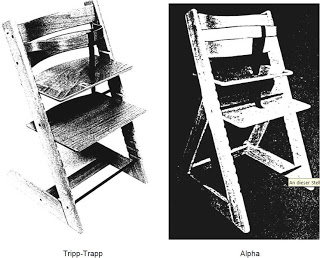
German case law isn’t famous for awarding exorbitant damages in IP infringement matters. Now, it appears as if German Courts are even going into reverse: Just published, the German Federal Supreme Court has only recently decided, in Case I ZR 98/06 Tripp-Trapp-Stuhl, that copyright infringers are not obliged to render the whole profit made with the infringing copy even when imitating one-to-one the work-in-suit (in this case, the well-known Tripp-Trapp child's chair). The court found that, in such a case, the decision of the consumer to buy the copy (and not the original) was not based “entirely on the infringement” but rather on other factors such as “functionality” or “good price” of the copy. In short, the consumer is buying the copy not only because of it being identical with the original, but because it is cheaper.
This observation doesn’t seem to be new or surprising – why should I buy a copy if it isn’t even cheaper than the original? In fact, there is most probably no copy that isn’t offered at a better price than the original. But this is no excuse for courts to let copyright infringers get away with some of their profits. Should these people really be rewarded by being allowed to keep a part of their profits because they sell their copies for less (and clearly detracting buyers from acquiring the original), whereas infringers selling their copy at the price of the original (highly unlikely, though) would have to render the entire amount of their profits? And how can a court determine and weigh factors such as “functionality”, “low price”, “imitation” etc., factors that are decisive, according to the court, for calculating the percentage to be deducted from the profits?
The decision raises more questions than it answers – including the critical question to what extent this reasoning will be transferred to other IP rights. If German courts answer this in the affirmative, Germany would indeed find itself before a change of paradigm.
Posted by: David Musker @ 18.34German case law isn’t famous for awarding exorbitant damages in IP infringement matters. Now, it appears as if German Courts are even going into reverse: Just published, the German Federal Supreme Court has only recently decided, in Case I ZR 98/06 Tripp-Trapp-Stuhl, that copyright infringers are not obliged to render the whole profit made with the infringing copy even when imitating one-to-one the work-in-suit (in this case, the well-known Tripp-Trapp child's chair). The court found that, in such a case, the decision of the consumer to buy the copy (and not the original) was not based “entirely on the infringement” but rather on other factors such as “functionality” or “good price” of the copy. In short, the consumer is buying the copy not only because of it being identical with the original, but because it is cheaper.
This observation doesn’t seem to be new or surprising – why should I buy a copy if it isn’t even cheaper than the original? In fact, there is most probably no copy that isn’t offered at a better price than the original. But this is no excuse for courts to let copyright infringers get away with some of their profits. Should these people really be rewarded by being allowed to keep a part of their profits because they sell their copies for less (and clearly detracting buyers from acquiring the original), whereas infringers selling their copy at the price of the original (highly unlikely, though) would have to render the entire amount of their profits? And how can a court determine and weigh factors such as “functionality”, “low price”, “imitation” etc., factors that are decisive, according to the court, for calculating the percentage to be deducted from the profits?
The decision raises more questions than it answers – including the critical question to what extent this reasoning will be transferred to other IP rights. If German courts answer this in the affirmative, Germany would indeed find itself before a change of paradigm.
Tags: chair, copyright, damages, germany, infringement,
Perm-A-Link: https://www.marques.org/blogs/class99?XID=BHA62
MARQUES does not guarantee the accuracy of the information in this blog. The views are those of the individual contributors and do not necessarily reflect those of MARQUES. Seek professional advice before action on any information included here.
The Class 99 Archive

