
CLASS 99
The blog for design law, in Europe and worldwide. This weblog is written by a team of design experts and fans. To contribute, or join us, or for any other reason, email class99@marques.org.
Want to receive Class 99 by email?
Click here subscribe for free.
Click here subscribe for free.
Who we all are...
MONDAY, 12 NOVEMBER 2012
Beauty - it's in the eye of the expert
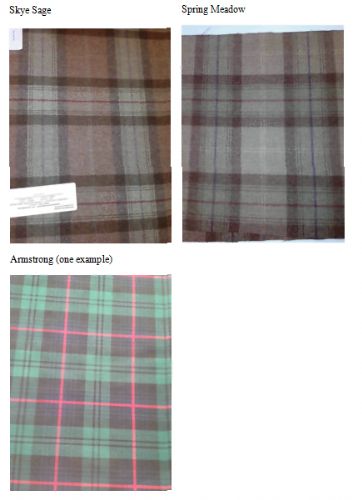 Since it has already been covered by our colleagues at the 1709 Blog and elsewhere, this is just a short note on Judge Birss' fascinating copyright judgment concerning genuine Highland tartans designed, woven and infringed in England (Moon v Thornber [2012] EWPCC 37). Infringement was found, on the basis of similarity, access and a wholly unconvincing defence of independent creation.
But infringement of what? The pleaded copyright work was the "Ticket Stamp", which contained instructions and some kind of visual representation of the tartan. That was reproduced in some sense in the claimant's fabric. The defendant then produced their own fabric, via their own "ticket stamp", derived so as to resemble the claimant's.
Judge Birss held that the ticket stamp had two copyrights, as both a literary and an artistic work. The defendant's ticket stamp was an infringement of the former, although their fabric was not. However, the defendant's fabric was an infringement of the claimant's ticket stamp in its character as an artistic work.
So far so good. But according to the Judge:
"The Skye Ticket Stamp is not a drawing of the Skye Sage fabric and if a layman looks at the Skye Ticket Stamp, all they see are two pages of words and numbers. However Mr Aveyard and Mr Wellings gave clear evidence which shows in my judgment that to an experienced fabric designer, the ticket has real visual significance. Mr Wellings said he could look at a weaving ticket and visualise what the fabric looks like. Mr Aveyard said that he visualised the design and then recorded it in a ticket. Thus it seems to me that to those people, the ticket has a visual significance. I do not see why it matters that the visual significance is only apparent to some people. Apart from anything else the people concerned are the very people working in this field. Moreover there is no problem of subjectivity in this conclusion. We can all see what Mr Aveyard and Mr Wellings can see, albeit we need the loom to actually make the fabric in order to do so. Experts however can see it without the loom.
Mr Turner submitted that there was no visual resemblance between the Spring Meadow fabric and the Skye Ticket Stamp. That is true in the sense that, as a lay person looking at them, one is a plaid design of fabric while the other is a collection of words, letters and numbers. However I rely again on the impact of the evidence of Mr Wellings and Mr Aveyard. To someone who can see the fabric design from looking at the ticket (or vice versa) the one has a clear visual resemblance to the other. In my judgment the appearance of Spring Meadow reproduces the whole or a substantial part of the appearance of Skye Sage and thus is a reproduction of the whole or a substantial part of artistic work embodied in the Skye Ticket Stamp within the meaning of s17 of the 1988 Act. Making Spring Meadow fabric involves an act of copying that artistic work and is an act of infringement." Whilst initially surprising, I suppose this is not controversial these days since copyright works such as computer programs might often require an expert eye. Judge Birss' decision is historically consistent with previous cases such as Brigid Foley v Elliott [1982] RPC 433. We did once have a UK "lay recognition" defence, in s9(8) of the Copyright Act 1956, but that probably would not have applied to fabrics: "The making of an object of any description which is in three dimensions shall not be taken to infringe the copyright in an artistic work in two dimensions, if the object would not appear, to persons who are not experts in relation to objects of that description, to be a reproduction of the artistic work." It was in any event severely undercut by the House of Lords in LB Plastics v Swish who held that the "non-expert" could take account of text and was "credited with some ability to interpret design drawings", and it has long since been swept away. But if the comparison can be between a ticket stamp (as artistic work) incomprehensible to the lay observer and a fabric, which are poles apart, it seems artificial to continue to maintain the rigid walls between separate protectable "boxes" such as "artistic work" and "literary work". If the ticket stamp met the protection criteria for copyright as either, and was reproduced, why should the category matter? The claimant argued that the CJEU decision in Infopaq (Case C-5/08) had the effect of removing the basis for such "boxes" altogether. Judge Birss declined to follow them, "[h]owever tempting it may be". Is this the end of the argument against "boxes" based on Infopaq? I suspect not. We will keep you informed. Posted by: David Musker @ 14.17
Tags: copyright, copyright in design documents, infringement, plaid, tartan,
Perm-A-Link: https://www.marques.org/blogs/class99?XID=BHA390
Beauty - it's in the eye of the expert
But infringement of what? The pleaded copyright work was the "Ticket Stamp", which contained instructions and some kind of visual representation of the tartan. That was reproduced in some sense in the claimant's fabric. The defendant then produced their own fabric, via their own "ticket stamp", derived so as to resemble the claimant's.
Judge Birss held that the ticket stamp had two copyrights, as both a literary and an artistic work. The defendant's ticket stamp was an infringement of the former, although their fabric was not. However, the defendant's fabric was an infringement of the claimant's ticket stamp in its character as an artistic work.
So far so good. But according to the Judge:
"The Skye Ticket Stamp is not a drawing of the Skye Sage fabric and if a layman looks at the Skye Ticket Stamp, all they see are two pages of words and numbers. However Mr Aveyard and Mr Wellings gave clear evidence which shows in my judgment that to an experienced fabric designer, the ticket has real visual significance. Mr Wellings said he could look at a weaving ticket and visualise what the fabric looks like. Mr Aveyard said that he visualised the design and then recorded it in a ticket. Thus it seems to me that to those people, the ticket has a visual significance. I do not see why it matters that the visual significance is only apparent to some people. Apart from anything else the people concerned are the very people working in this field. Moreover there is no problem of subjectivity in this conclusion. We can all see what Mr Aveyard and Mr Wellings can see, albeit we need the loom to actually make the fabric in order to do so. Experts however can see it without the loom.
Mr Turner submitted that there was no visual resemblance between the Spring Meadow fabric and the Skye Ticket Stamp. That is true in the sense that, as a lay person looking at them, one is a plaid design of fabric while the other is a collection of words, letters and numbers. However I rely again on the impact of the evidence of Mr Wellings and Mr Aveyard. To someone who can see the fabric design from looking at the ticket (or vice versa) the one has a clear visual resemblance to the other. In my judgment the appearance of Spring Meadow reproduces the whole or a substantial part of the appearance of Skye Sage and thus is a reproduction of the whole or a substantial part of artistic work embodied in the Skye Ticket Stamp within the meaning of s17 of the 1988 Act. Making Spring Meadow fabric involves an act of copying that artistic work and is an act of infringement." Whilst initially surprising, I suppose this is not controversial these days since copyright works such as computer programs might often require an expert eye. Judge Birss' decision is historically consistent with previous cases such as Brigid Foley v Elliott [1982] RPC 433. We did once have a UK "lay recognition" defence, in s9(8) of the Copyright Act 1956, but that probably would not have applied to fabrics: "The making of an object of any description which is in three dimensions shall not be taken to infringe the copyright in an artistic work in two dimensions, if the object would not appear, to persons who are not experts in relation to objects of that description, to be a reproduction of the artistic work." It was in any event severely undercut by the House of Lords in LB Plastics v Swish who held that the "non-expert" could take account of text and was "credited with some ability to interpret design drawings", and it has long since been swept away. But if the comparison can be between a ticket stamp (as artistic work) incomprehensible to the lay observer and a fabric, which are poles apart, it seems artificial to continue to maintain the rigid walls between separate protectable "boxes" such as "artistic work" and "literary work". If the ticket stamp met the protection criteria for copyright as either, and was reproduced, why should the category matter? The claimant argued that the CJEU decision in Infopaq (Case C-5/08) had the effect of removing the basis for such "boxes" altogether. Judge Birss declined to follow them, "[h]owever tempting it may be". Is this the end of the argument against "boxes" based on Infopaq? I suspect not. We will keep you informed. Posted by: David Musker @ 14.17
Tags: copyright, copyright in design documents, infringement, plaid, tartan,
Perm-A-Link: https://www.marques.org/blogs/class99?XID=BHA390
MARQUES does not guarantee the accuracy of the information in this blog. The views are those of the individual contributors and do not necessarily reflect those of MARQUES. Seek professional advice before action on any information included here.
The Class 99 Archive

