
Now in its twelfth year, Class 46 is dedicated to European trade mark law and practice. This weblog is written by a team of enthusiasts who want to spread the word and share their thoughts with others.
Click here subscribe for free.
Who we all are...
Report on personality and publicity rights
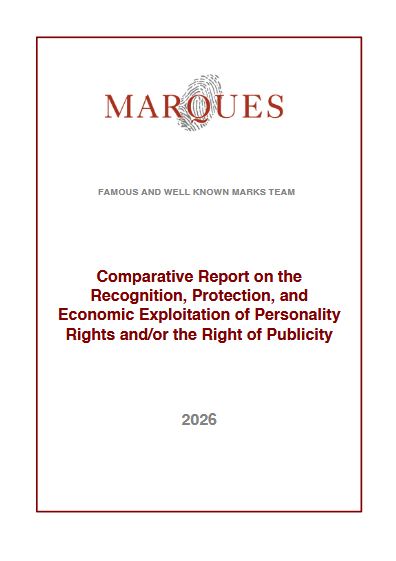 The MARQUES Famous and Well-Known Marks Team has published a new comparative report on the recognition, protection and economic exploitation of personality rights and/or the right of publicity.
The report has been prepared by members of the Non-Traditional Marks Sub-Team over the past two years and is one of the most extensive comparative studies of the subject available.
It is available to download from the Team’s page on the MARQUES website (log-in required).
The publication is based on a survey of legal practitioners in 27 countries. The survey comprised 41 questions.
It aims to provide a broad comparative understanding of how different legal systems protect a person’s identity and its constituent attributes including name, nickname, pseudonym, image, likeness, voice, signature, gestures, mannerisms and other identifying characteristics.
The report also examines the legal protection afforded to historical figures and infamous personalities, such as Al Capone or Pablo Escobar. It further explores the relationship between personality rights and freedom of expression, addressing the circumstances in which the use of a person's name, image or likeness may be permissible without consent, particularly in connection with parody, satire, criticism, news reporting, artistic expression and other matters of public interest. In addition, it reviews the legal tools available to combat deepfakes.
The report includes an executive summary, which provides an overview of the main findings, similarities and differences. This is followed by question-by-question analysis and a summary of the 32 principal findings and conclusions.
The survey identified three broad legal models:
- A personality-rights model, principally found in civil-law jurisdictions
- A fragmented or multiple-remedy model, in which no general personality right or right of publicity exists
- A proprietary right of publicity or specific commercial-identity model, principally represented by the United States
A key finding of the survey is that the personal nature of the underlying right does not necessarily prevent the economic exploitation of its constituent elements.
The report concludes that the international protection of personal identity is neither uniform nor based on a common legal doctrine. The same unauthorised use may be treated as an infringement of dignity and personality in one jurisdiction, false endorsement or passing off in another, and misappropriation of a proprietary publicity right in a third.
However, the survey also reveals substantial convergence. Most jurisdictions recognise that personal identity deserves protection against at least certain unauthorised uses; that names, images, voices, and other attributes may possess economic value; that commercial use may generally be authorised; and that protection must be balanced against freedom of expression and the public interest.
The principal remaining challenge is that comparable interests are protected through different rights, terminology, remedies, limitations and enforcement mechanisms. These differences become particularly significant in the digital environment, where uses of identity are instantaneous, borderless, increasingly realistic and frequently difficult to attribute to an identifiable infringer.
The Sub-Team would like to thank everyone who supported this project with contributions. If you have any questions about the report, please contact Juan Carlos Durand or another member of the Team.
Posted by: Blog Administrator @ 09.01Tags: Personality, publicity rights, non-traditional marks,


 Sharing on Social Media? Use the link below...
Perm-A-Link: https://www.marques.org/blogs/class46?XID=BHA5486


