
Now in its twelfth year, Class 46 is dedicated to European trade mark law and practice. This weblog is written by a team of enthusiasts who want to spread the word and share their thoughts with others.
Click here subscribe for free.
Who we all are...
40th Annual Conference – Parts 7 and 8
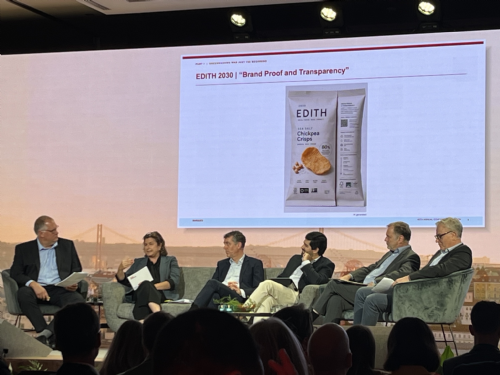 The final day of this year’s Annual Conference in Lisbon began with a discussion of the impact of labelling and environmental laws on trade marks in Europe (Part 7 – Greenwashing was just the beginning). It was moderated by Jan-Caspar Rebling, Stobbs IP Limited, UK, Member of the MARQUES Regulatory Team
Gregor Versondert, Procter & Gamble International Operations S.A, Switzerland, Member of MARQUES Council and Regulatory Team, started the discussion by talking about brand equity. He said this starts with brand awareness and sustainability is increasingly part of it: “A good environmental record does make lots of consumers go for one product rather than another. It will stay with us.”
Jose Maria Azeredo, Lidl, Portugal, agreed, saying that what was once perceived as added value will become common ground thanks to EU regulations. But he added a question is: “How much sustainability can my consumer afford?” as private label products are forced ot become higher priced. Dr Andreas Gayk, Markenverband eV, added that long-term sustainability is key to brand value.
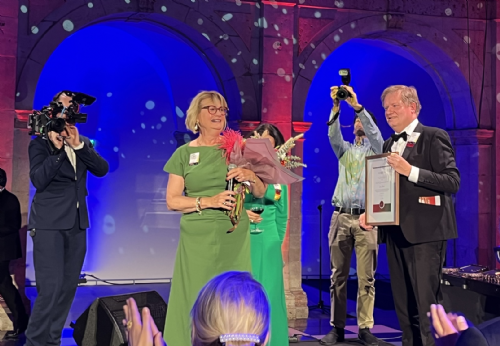 |
| Ingrid De Groot was honoured at the Gala Dinner for 30 years of service to MARQUES, including as Internal Relations Officer, and presented with lifetime membership. |
Bernd Weichhaus, JBViniol Partnerschaft, Germany, Member of the MARQUES Regulatory Team, introduced the Empowering Consumers for the Green Transition (EmpCo) Directive. He said that consumer issues, and particularly sustainability issues, are driving regulation and discussed a case study of Edith chickpea crisps, and their claim to have “zero environmental impact”. He said the environmental claims were ambiguous and lacked information.
Bernd said the EmpCo directive has a big impact on trade marks as it prohibits certain labelling which is not justified or supported. It also provides that products claiming to be certified must meet the requirements of that certification. He shared several examples of trade mark applications that include terms such as eco, which have been refused due to descriptiveness or lack of distinctiveness.
The directive marks a shift from market-led sustainability to evidence-based sustainability, said Bernd, who described the enforcement actions that can be taken. Gregor said that, while the legal remedies can be severe, the biggest risk is loss of reputation among consumers.
Eva-Maria Strobel, Baker McKenzie Switzerland AG, Switzerland, Member of the MARQUES Regulatory Team, discussed the digital product passport. “This is a digital file that tells us about the product – where it comes from, what materials, how it performs environmentally and whether it can be repaired or recycled,” she said, adding that it is one of the main tools in the EU’s regulatory framework on green claims. “It’s like the product biography.”
The first passports, for batteries, are being introduced in 2027 with other products to follow by 2029. Eva-Maria said it matters to brands because it means the consumer no longer has to trust what the brand says – they can check. This means the emphasis moves to the data behind the product, she said.
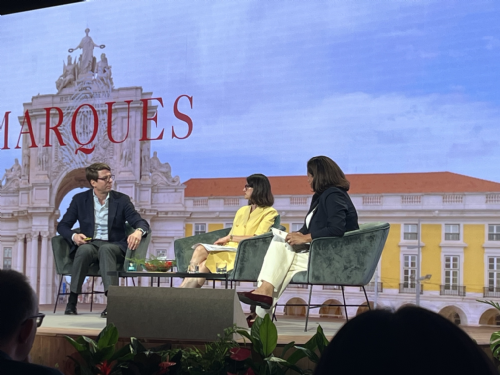 The final session of the Annual Conference, Part 8 comprised the regular review of CJEU and EU General Court case law, focusing on: monkeys, furniture and money. It was moderated by Claire Lehr, Edwin Coe LLP, UK, Chair of the MARQUES Programming Team, and featured Sebastian Fischoeder, Taylor Wessing Partnerschaftsgesellschaft mbB, Germany, Member of the MARQUES Amicus Curiae Team, and Eleonora Viegas, Judge Court of Appeal Lisbon, President of the IP Section, Vice President of the Court of Appeal, Portugal
They discussed three topics arising from recent or pending cases:
- The CJEU judgment in Case C-337/22P EUIPO v Nowhere, in which the Court said that EUTM opposition requirements must be met at the time of the relevant EUIPO or Board of Appeal decision. “The EUIPO or BoA must assess the requirements for the opposition not only at the application or priority date of the subsequent trade mark, but also when deciding on the opposition,” explained Sebastian. The key takeaway is: love and cherish your trade mark!
- The recent Case C-298/23 IKEA concerning IP rights and freedom of expression, in which the CJEU set out the criteria for assessing due cause. Judge Viegas described this as “a fascinating case” and said: “The Court made it very clear that it is the alleged infringer who must establish why, in the interest of freedom of expression, it may use a well-known trade mark.” The panel also briefly discussed whether the Court had gone too far in directing the national court in its judgment.
- Case C-573/25, a referral from Germany on the reimbursement of legal costs which raises questions about statutory fee recovery schemes. This led to a lively audience discussion about the pros and cons of statutory schemes. The Court’s judgment is expected within the next year.
- For all three cases, the speakers ran a poll for the audience to vote on their decision and also invited comments from the floor.
The Annual Conference concluded with remarks by MARQUES Chair Claudia Pappas, a video of highlights and a look forward to the 41st Annual Conference, which will be in Athens, Greece.
Photos taken by MARQUES staff and editor. Speakers do not necessarily represent the views of any organisations mentioned or of MARQUES.
Posted by: Blog Administrator @ 15.18
Tags: Annual Conference, Lisbon,


 Sharing on Social Media? Use the link below...
Perm-A-Link: https://www.marques.org/blogs/class46?XID=BHA5483


