
Now in its twelfth year, Class 46 is dedicated to European trade mark law and practice. This weblog is written by a team of enthusiasts who want to spread the word and share their thoughts with others.
Click here subscribe for free.
Who we all are...
40th Annual Conference, Lisbon – Parts 3 and 4
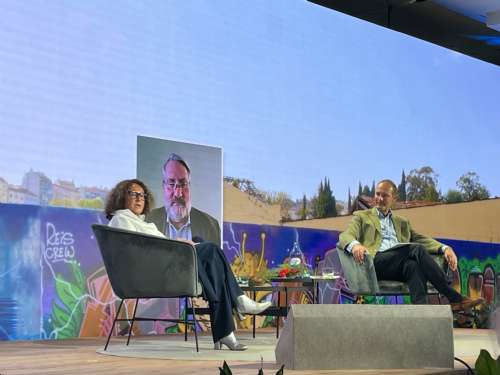 The first afternoon of this year’s Annual Conference featured sessions on IP finance and the EUIPO Boards of Appeal
Roland Mallinson, Winston Taylor International LLP, UK, Member of MARQUES Executive and Council, introduced Part 3 – Unlocking the power of IP focused on IP-backed financing (pictured right) with some statistics from a recent EUIPO report on IP financing.
Donald Broadfield Jr, Managing Director & Senior Attorney/Chief IP and Data Counsel, American Airlines, Inc, USA described four trade mark-backed loans that American Airlines has secured over the past 25 years, raising billions of dollars. This included a bond with a very low interest rate, backed by trade marks such as American Airlines and AAdvantage.
Donald said that lenders are generally well educated on brand value. Tatiana Whytelord, Intelligent Brand Extension LLC, USA, agreed, saying it is notable how little corporate leadership values IP compared to people on the other side. However, said Donald, lenders often do not understand nuances of trade mark law, such as minor changes to a specification and renewal notices. “Not all buyers have the right people to have this mindset,” said Tatiana so buyers with IP departments have a big advantage. “With lenders you need to be very conservative,” she added.
The panel discussed how approaches vary around the world. Donald said many jurisdictions did not have an established approach to IP-backed loans or had high requirements: these include Spain and Japan. “It’s not an easy process,” said Roland, who advised American Airlines on some of the deals.
Tatiana challenged the idea maintained by many companies that IP is a cost centre and stressed the importance of having an aligned system for, and purpose behind, protecting the IP. She also addressed the risks raised by personalised or founder brands.
Other topics covered by the panel included trade mark licensing and maintaining control over brand usage, ad agencies seeking to register IP rights, drafting contracts and litigation, disputes with commercial partners (such as supermarkets and online travel agencies) and franchising. “The number of loans backed by IP will increase over time,” said Donald, pointing out that trade marks are unusual assets because they often grow in value.
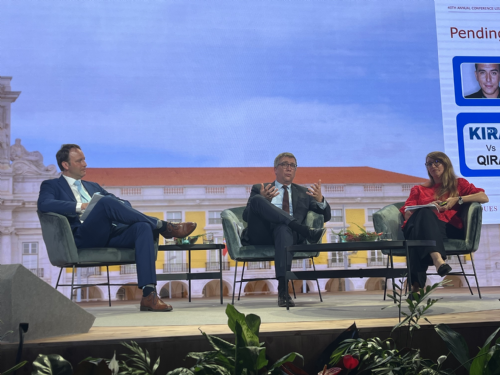 The final session of the day, Part 4 – New perspectives from EUIPO (pictured left), featured Sven Sturmann, President of the EUIPO Boards of Appeal, Spain and was moderated by Johannes Fuhrmann, Bomhard Intellectual Property, SL, Spain, Member of MARQUES Council and Chair of the European Trademark Law & Practice Team and Andreea Bende, Minded Counsels SRL, Romania, Vice-Chair of the MARQUES European Trademark Law & Practice Team.
The session covered three main topics: the Boards’ approach to generally understood English terms (such as smart, easy, online, style and shop); activities to enhance the quality and consistency of its decisions; and cooperation activities.
Mr Sturmann said the first is “a really tricky topic” that arises in many appeals. He stressed the importance of evidence, such as surveys, but recognised the challenges of doing this. Andreea referred to two cases: in CRAFT v CRAFT GEAR for goods in class 25, a likelihood of confusion was found but in SQUIZZY v SQUEEZED TO DEATH for goods in class 32, there was no likelihood of confusion.
Sven explained the Boards’ non-binding methodology for assessing basic English terms, which sets out circumstances in which English can be viewed as a matter of common knowledge. He said the aim is to be “as objective as possible” This has been applied in cases including R 2596/2023-2 iTEC SkyNex v SKYNET, R 1921/2025-4 wonderjeans v W wonders and R 1752/2024-1 G MOTION v GM GERMANY MOTIONS.
 In two recent cases, T-635/25 Health Labs Care and T-497/25 Almaviva, the EU General Court has confirmed and elaborated the methodology.
To promote consistency, the Boards have introduced case-law reports, Grand Board of Appeal referrals, a case law analysis tracking system and user feedback on Board decisions. Mr Sturmann stressed that none of these activities will interfere with the independence of the Boards’ work. “I think there are a lot of things we can simplify,” he added, mentioning some initiatives with judges and efforts to promote mediation.
The Annual Conference continues until Friday. Further reports will be posted on the Class 46 and Class 99 blogs. Photos taken by MARQUES staff and editor. Speakers do not necessarily represent the views of any organisations mentioned or of MARQUES.
Posted by: Blog Administrator @ 18.38Tags: Annual Conference, Lisbon,


 Sharing on Social Media? Use the link below...
Perm-A-Link: https://www.marques.org/blogs/class46?XID=BHA5481


