Now in its twelfth year, Class 46 is dedicated to European trade mark law and practice. This weblog is written by a team of enthusiasts who want to spread the word and share their thoughts with others.
Click here subscribe for free.
Who we all are...
Copyright, AI and the EU’s next steps
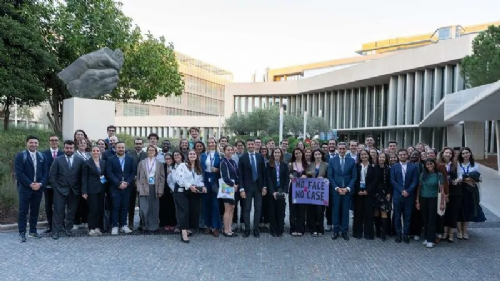 Pigi Konstantinou of the MARQUES Copyright Team shares some takeaways from EUIPO’s first copyright conference.
The EUIPO held its first-ever copyright conference at its headquarters in Alicante on 20–21 November 2025, marking a clear strategic shift of the Office toward deeper engagement with copyright matters.
The event celebrated the launch of the new EUIPO Copyright Knowledge Center, which provided the framework for two days of rich discussions, insightful presentations and various cultural activities.
The audience reflected the diversity of the copyright ecosystem: policy makers, major tech companies, academics, performers’ and authors’ representatives, as well as copyright experts and IP practitioners.
In parallel with the main sessions, the EUIPO hosted live concerts, dance performances, local creators showcasing handmade works, the unveiling of a mural, DJ sets, and a renowned visual artist drawing live throughout the conference.
Key takeaways from the presentations
A central theme was the EUIPO’s expanding role in the copyright field. The Office presented its ongoing initiatives, such as the Out-of-Commerce Works Portal, the Orphan Works Database, and AGORATEKA, and explained the mission of the Knowledge Center: to provide an authoritative hub for copyright-related news, case law, studies, and training materials and to support policy dialogue.
A forthcoming Copyright View service aims to enhance access to information on copyright status, authorship and rights ownership across Europe.
CJEU perspective
Maciej Szpunar, First Advocate General at the CJEU, stressed the crucial role of the Court in interpreting core legal notions amid fast-moving technological developments. He identified key structural challenges the internet and digital technologies pose to copyright law:
- Erosion of territoriality
- Transformation of storage, transmission and access to information
- Uncertainty surrounding exhaustion in the digital environment
- Reconfiguration of liability rules, with secondary liability becoming more central than primary infringement
- Increasing tension among fundamental rights and the need to balance them
He also referred to two of his recent opinions: HP Netherlands (C-496/24) on the private copy exception and Meta Platforms Ireland (Case C-797/23) on the press publishers’ right.
Ensuring cultural diversity in the age of AI
Professor Martin Senftleben focused on safeguarding both fair remuneration for authors and the cultural diversity of AI systems, an urgent priority, in his view. His proposals favoured regulating AI outputs rather than restricting inputs and emphasised collective licensing schemes as a more viable solution than individual licensing.
He outlined a model in which AI systems freely mine works, combined with levies at market entry and collective management of remuneration, with an opt-out pathway for rights holders seeking individual licensing.
Regulatory horizons: towards a General Copyright Regulation?
MEP Axel Voss underscored the persistent need for updated legislation. He floated the possibility of a General Copyright Regulation, analogous to the GDPR, to overcome fragmentation arising from national divergences.
Article 4 of the DSM Directive, he clarified, was never designed to address generative AI. In his view, the solution lies in licensing mechanisms and transparency obligations grounded in international law.
Mr Voss also advocated for the creation of an EUIPO-managed opt-out register, providing standardised, machine-readable notices for AI developers and potentially operating as a one-stop-shop licensing interface.
Creators’ concerns
Artists’ and authors’ representatives repeatedly stressed the importance of awareness, noting unequal national protection standards and the rapid evolution of AI tools. While many expressed concerns, some acknowledged new creative opportunities offered by AI.
Interestingly, the much-debated idea of an EUIPO copyright registration system remained largely peripheral. Nonetheless, collecting societies such as GEMA voiced significant reservations regarding its feasibility and effect on existing rights management structures.
Conclusion
The conference marked an important first step in the EUIPO’s growing involvement in copyright policy. How this initiative will unfold, especially in the complex landscape of generative AI, remains to be seen.
What is clear is that the conversation has begun, and the Office now stands at the threshold of shaping a more coherent and future-proof European copyright framework.
Pigi Konstantinou is a partner at Souriadakis Tsibris, Greece and a member of the MARQUES Copyright Team
Read more about the Copyright Conference, and view recordings of the sessions, on EUIPO’s website here, from where the picture above is taken
Posted by: Blog Administrator @ 09.01Tags: EUIPO, copyright, AI,


 Sharing on Social Media? Use the link below...
Perm-A-Link: https://www.marques.org/blogs/class46?XID=BHA5412


