
Now in its twelfth year, Class 46 is dedicated to European trade mark law and practice. This weblog is written by a team of enthusiasts who want to spread the word and share their thoughts with others.
Click here subscribe for free.
Who we all are...
EU activates protection on CIGI products
As of 1 December 2025, Regulation (EU) 2023/2411 on the protection of Craft and Industrial Geographical Indications (CIGIs) applies. That means that registration for said names can be filed and benefit, under certain conditions, from EU-wide protection. María Ceballos of the MARQUES GI Team reports.
Introducing CIGIs
As discussed in the Talking MARQUES podcast and at one of the workshops during last Annual Conference in The Hague, until now protection in the EU for craft and industrial products had not been harmonised: only some EU countries granted it, under different figures, scopes and administration.
The existing GI system has so far been applicable only to agricultural GIs (AgriGIs), which up to date protects more than 3,600 names of wines, food and spirit drinks. The CIGI system is similar in many aspects to that of AgriGIs.
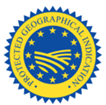 Protection of a CIGI is granted by registration, under the figure of Protected Geographical Indication (PGI) (note that some food and wines GIs are protected as Protected Designations of Origin (PDOs), and spirit drinks strictly as Geographical Indications (GIs), but all enjoy the same scope of protection). Once a product name has been registered as a GI, producers may use the corresponding EU symbol, which in case of a “PGI” is shown on the right.
The EU GI Register, the official record of all protected GIs, is accessible through the public database GIview.
Registration requirements
With the new system, protection as a GI is granted not only to ‘craft products’, which are those produced either entirely by hand or with the aid of manual or digital tools or by mechanical means whenever the manual contribution is an important component of the finished product; but also to ‘industrial products’, namely those produced in a standardised way, including serial production and the use of machines.
To succeed in the registration of a CIGI, three cumulative requirements must be met:
- The product should be rooted in or originate in a specific place, region or country;
- At least one of the production stages (such as storage, processing, packaging) should take place in the defined geographical area; and
- At least one quality or characteristic of the product shall be attributable to the area.
Producers may apply through a producer group or a single producer under certain conditions. Each application must include, among other documents, a “product specification” outlining the name, production process and geographical area.
Applicants in most EU Member States shall follow a two-step registration process (Standard procedure), starting at national level, when the authority may charge fees, review the application and run a national opposition procedure; and continuing at EU level: the application is then assessed by the EUIPO, whose GI Division handles the EU-wide opposition procedure and decides on protection and registration.
Exceptionally, and because (among other reasons) they have no system at national level in place to manage CIGIs, the EU Commission has allowed applicants from Denmark, Finland, Lithuania, Luxembourg, Malta, the Netherlands and Sweden to follow a one-step process (Direct procedure) and apply directly to the EUIPO.
Applications for products originating in non-EU countries must be filed before the EUIPO either by the applicants or through the competent authorities of their countries.
Those names which were already protected in a Member State, under national norms, can follow a fast-track registration process before EUIPO, with no opposition procedure. This new EU system will replace the previously existing national norms for craft and industrial products, if there are any.
Detailed information about the filing process is available on the GI Hub on the EUIPO website and the GIportal information page.
Scope of protection
CIGIs will enjoy the same scope of protection as AgriGIs and be protected against any direct or indirect commercial use of a registered name, but also against any imitation, evocation, any other false or misleading indication and any other practice liable to mislead the consumer as to the true origin of the product. This applies even when the true origin of the product is indicated or when expressions such as “type”, “style” or similar are used. CIGIs will also be protected against use in e-commerce and the registration of domain names that reproduce or evoke the GI.
 As evidenced with the Agri-GIs in the past 30 years, this enhanced protection framework contributes decisively to preserving the reputation of products that, in many cases, have been linked to a particular territory for centuries and brings many social and cultural benefits. PGIs boost cultural and heritage tourism in their region of origin, safeguard traditional skills, support local employment and help consumers recognise genuine, high-quality European products.
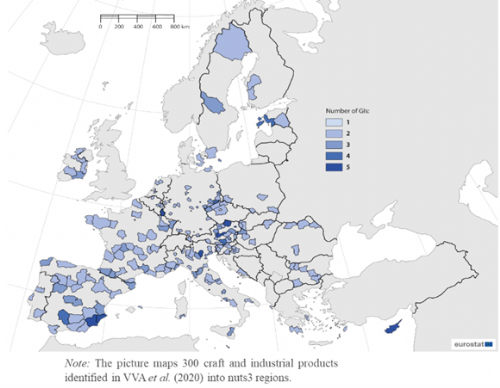
CIGIs will be particularly useful as hundreds of products have been identified as potentially eligible for GI protection in the EU, including a wide range of goods, such as glassblowing, pottery, cutlery, jewellery, shoes, textiles, porcelain and musical instruments. A map (2020, shown above right) shows up to 300 craft and industrial products in different EU regions.
This new protection completes the EU market for GIs and will offer a unique economic opportunity for craft and industrial producers to improve access to high value market. Cheers to that!
María Ceballos is a partner of Curell Suñol and a member of the MARQUES GI Team
Posted by: Blog Administrator @ 11.59Tags: CIGI, EU, GI Team,


 Sharing on Social Media? Use the link below...
Perm-A-Link: https://www.marques.org/blogs/class46?XID=BHA5410


