
Now in its twelfth year, Class 46 is dedicated to European trade mark law and practice. This weblog is written by a team of enthusiasts who want to spread the word and share their thoughts with others.
Click here subscribe for free.
Who we all are...
Book review: Intellectual Property Enterprise Court: Practice and Procedure
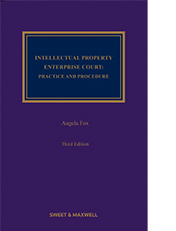 Charlotte Duly of the Education Team reviews a new book Intellectual Property Enterprise Court: Practice and Procedure, 3rd edition, by Angela Fox (published by Sweet & Maxwell, priced at £245 and available here).
This book was published at the end of November 2021 and offers a comprehensive guide to the practice and procedure of the Intellectual Property Enterprise Court (IPEC). For me, having recently had the pleasure of marshalling His Honour Judge Hacon at the IPEC, this was a timely publication covering the inner workings of this specialist IP court.
The IPEC aims to be a streamlined and cost-effective means of resolving IP disputes, with the likely spend estimated to be 20% to 25% of High Court proceedings – by no means a cheap option but the IPEC certainly makes litigation more accessible, allowing more rights holders to enforce their IP rights. This book is a useful text to assist in navigating proceedings before the IPEC in conjunction with the Civil Procedure Rules, IPEC Guide and Chancery Guide.
History of the IPEC
The history of IP and developments in law and practice are always fascinating and this text provides a history of IP litigation in the English courts and the background leading to the development of the Patents County Court through to the IPEC. This is followed by a useful explanation of judicial staffing of the court, its location and administration.
Unlike the High Court, the IPEC is open to a range of legal representatives including solicitors, patent attorneys and trade mark attorneys, who may all conduct proceedings and appear before the Court, aiding the accessibility of proceedings.
Brexit and other updates
With talk of Brexit having not yet departed us, this text includes commentary on Brexit related procedural changes. Prior to the end of the Brexit transition period, the IPEC was an EU trade mark court with jurisdiction extending across the EU but that position has now changed.
Other important updates are also covered, including the amendments to the law on unjustified threats, Part 36 and indemnity costs in the IPEC’s capped costs regime, the latest rules governing statements of truth, witness statements, routes of appeal, costs awards and default judgment.
When to use IPEC
A handy table makes it clear when the IPEC may have jurisdiction, detailing a range of issues in relation to patents, trade marks, designs and other forms of IP. Company names and domain names are also considered in the book.
The IPEC is aimed at claims to damages or an account of profits not exceeding £500,000. There is a small claims route for claims valued at £10,000 or less and this is explored in its own section of the book.
The text covers pre-action matters in detail. Litigation before the IPEC has differences compared to elsewhere in the High Court. These differences, as well as determining whether the IPEC may be the right forum, are important considerations prior to action being commenced. This text provides a handy guide for all of the various factors to be worked through before settling on IPEC as the forum. The book further covers all aspects of proceedings including case management, applications, evidence and disclosure, trial, the rules of appeals, remedies, costs and enforcement. As well as written text, the book includes charts and diagrams to explain various aspects of IPEC proceedings. Overall this book provides an incredibly useful guide to a court that is central to UK IP enforcement.
Charlotte Duly is Head of Brand Protection at Charles Russell Speechlys LLP and a member of the MARQUES Education Team.
Posted by: Blog Administrator @ 09.18Tags: IPEC, Hacon, Brexit,


 Sharing on Social Media? Use the link below...
Perm-A-Link: https://www.marques.org/blogs/class46?XID=BHA5052


