
Now in its twelfth year, Class 46 is dedicated to European trade mark law and practice. This weblog is written by a team of enthusiasts who want to spread the word and share their thoughts with others.
Click here subscribe for free.
Who we all are...
The impact of global developments on IP - Annual Conference Part 2
“Our jobs are radically changing,” said moderator Gregor Vos of Brinkhof in The Netherlands, introducing Part 2 of the MARQUES Annual Conference, looking at the impact of global developments on IP. “The nature of our work and even the nature of our jobs will change,” he added.
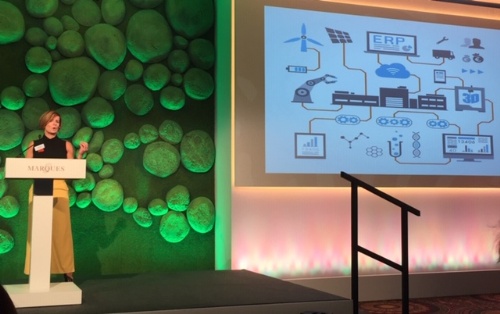 The speakers brought diverse perspectives to topics such as disruption, the benefits and challenges of technology, e-billing, legal marketing, security and compliance and how the practice of law will change.
Fourth Industrial Revolution
Disruption at work is happening to all of us, said Adrienne Gormley, Vice President of Global Customer Experience & Head of EMEA at Dropbox in Ireland. “We are living in the Fourth Industrial Revolution. It will have a profound impact on who we are as people, the way we live and the way we work … Even as a young company, we’ve had to take a hard look at disruption in our environment.”
Using the example of maps, she said consumers are demanding more and more of products – but get highly frustrated when brands don’t deliver, and are often quick to make their concerns public: “We bring this demand of customer expectation to the companies we work with.”
By 2025, she said, car-sharing will be much more common, there will be a transplant of a 3D printed liver and 3D-printed vehicles. A manufacturing company today could be a software company tomorrow. But this disruption also brings opportunities, said Adrienne, pointing to the example of new Dropbox, launched in June this year.
Disruption also affects workplaces, recruitment and retention, she added, with a greater focus on creativity, technology and lifelong learning. “People are the best possible brand ambassadors – how do you retain them?” she asked. Generation Z are digitally native, and expect technologies to add value in all aspects of their lives. “Digital and tech has to embed in every organisation in every sector in the world … and every person in every organisation,” she explained.
Buyer’s market
 Turning to the legal landscape, Ginevra Saylor, Director, Innovation Programmes, Gowling WLG in Canada said there has been a shift from a seller’s market to a buyer’s market. This is shown in greater access to law, more awareness of legal process and a shift in supply and demand. In addition, client expectations have changed: they want to know what a matter will cost, expect more innovative billing arrangements and want more valuable services, as well as demanding more transparency and responses 24/7.
Other changes affecting lawyers include the disaggregation of legal work, keeping more work in-house, globalization and new entrants. “As a law firm, your competition is the world over,” said Ginevra, adding that lawyers are responding by working more closely with clients, and collaborating with other firms and service providers.
In response to change, many law firms have built up a “patchwork” of technologies, but now there is a need to integrate these and ensure they work together, as well as with external providers. This enables new services such as client dashboards showing the progress of a case, said Ginevra, as well as the development of new tools such as predictive analytics. Challenges for firms include training, upgrades, new skills and legal competence and cybersecurity. “This gives us an opportunity to delight our clients and deliver truly valuable services, in ways that make more sense to clients,” she said. “These opportunities make the business of law really exciting.”
Becoming agile
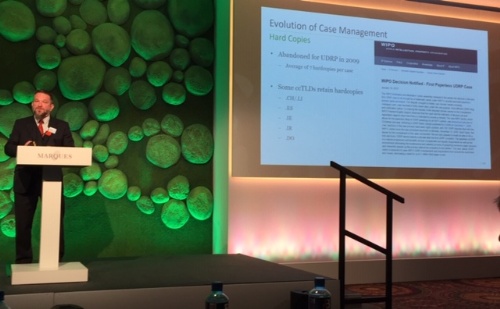 “Technology is everywhere,” added David Taylor of Hogan Lovells (Paris) LLP in his presentation, using the example of his domain name practice: case management has gone digital and hard copies have been eliminated for most UDRP disputes and online filing platforms have been developed. Technology also brings frustrations, but also opportunities, he said: “I try to work as remotely and as agilely as possible.”
Demand is going up, but productivity is already peaking, so tools such as document automation and automated contract review will become essential. “We need a balance between people, technology and process. We have to get that balance right,” concluded David.
Posted by: Blog Administrator @ 12.48Tags: Annual Conference, Dropbox, e-billing, disruption,


 Sharing on Social Media? Use the link below...
Perm-A-Link: https://www.marques.org/blogs/class46?XID=BHA4782


