 “Brexit means Brexit” – a wonderfully meaningless phrase. Nonetheless, it was the one adopted by Theresa May in 2016 when she campaigned, successfully, to become Prime Minister of the United Kingdom. More than two years later and only a few weeks before the current deadline for the UK to leave the European Union, we are still not entirely clear what Brexit will mean in practice for the UK and the EU. We may still have a “hard Brexit”, a “soft Brexit”, or something in between. (I am reminded of the tale of Goldilocks, who after finally deciding what she wanted, was eaten by bears.)
Whilst most of us scratch our heads trying to work out the possible permutations and consequences of Brexit, for some it represented an opportunity to register a trade mark, and not just in the UK. Applications have been filed in numerous countries to register BREXIT as a trade mark and in relation to a diverse range of goods and services.
They include: real estate affairs (Germany); sporting and cultural activities (Estonia); rental of video cassettes (France); hairdressers and beauty salons (France again); socks (Mexico); cosmetics (Poland); baked beans (Canada); whips (Italy); novelty toys for playing jokes (Germany); and, my personal favourite, “nutritional and dietary supplements featuring a blend of phytoextracted polyphenolic antioxidants, r-lipoic acid (rla), targeted vitamins (bl, b5, b6), selenium, kelp extract and high-potency nattokinase designed to maximize metal detoxification pathways in a phospholipid encapsulation system” (USA) (the USPTO does like a precise specification).
A range of responses
The applications have thrown up a range of responses from trade mark offices.
The USPTO has consistently refused to register BREXIT as a trade mark, including the Boston Beer Corporation’s application to register BREXIT as a trade mark in relation to hard cider (what happened to the soft cider option?) (US87083390). The applications were rejected on the basis that BREXIT consists solely of an informational message (the withdrawal of Britain from the EU) and not an indication of source, so it fails to function as a trade mark.
Within the EU, the results have been contradictory. The majority seem to be in favour of BREXIT™, with at least some applications for BREXIT in the UK, France and Italy proceeding smoothly to registration. However, there is a significant minority against the idea – the DPMA rejected Clipper Investments GmbH’s application to register BREXIT as a trade mark in Germany (DE3020162227382), because it lacked distinctive character.
So what is the view from the EU? In a rather impassioned decision, an examiner at the EUIPO refused to register BREXIT as a trade mark (EU015623631) in relation to a range of products, including energy drinks and electronic cigarettes. The examiner considered BREXIT lacked distinctive character, as the average consumer would perceive it as a mere motto for the withdrawal of the UK from the EU. More interestingly, she also believed that it was excluded from registration under Article 7(1)(f) EUTMR.
Article 7(1)(f)
As readers may remember from this team’s work on scandalous and immoral trade marks (shameless plug for our report which is available here), Article 7(1)(f) excludes “trade marks, which are contrary to public policy or to accepted principles of morality”. The examiner thought that citizens throughout the EU would be deeply offended if Brexit were to be registered as a trade mark and used as a mere produp[;vgct identifier. She considered that it would be particularly offensive to those who were in favour of the UK staying in the EU, and that the application constituted an attempt to play down the importance of Brexit as a serious moment in modern European history.
The Board of Appeal disagreed. In a decision from June 2017, it held that ‘BREXIT’ embodies a sovereign political decision, taken in conformity with the Lisbon Treaty, with no moral connotations whatsoever. Brexit may be contentious and controversial, but it is not immoral and “when applied as a brand to electronic cigarettes, beer or fruit juices … the political and hotly controversial message of ‘BREXIT’ dissolves in humour” (hilarious!). The Board of Appeal also considered that the mark had distinctive character – it is not descriptive in relation to the relevant goods, it is not laudatory, it is memorable, and it was an invented term.
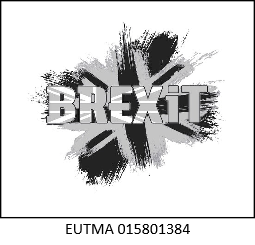
The story does not end there. An application by the same applicant, to register a logo featuring BREXIT (shown above), has been referred up to the EUIPO’s Grand Board because of the inconsistency of the decisions so far.
How is the EUIPO to determine if the use of Brexit as a trade mark would be perceived by the average consumer as immoral or not, or whether it lacks distinctive character? Surely that is a topic for a new referendum.
David Fyfield is an Associate in the IP team at Charles Russell Speechlys LLP in London
 Issue 097




 Make it your New Year Resolution to follow the