
CLASS 99
The blog for design law, in Europe and worldwide. This weblog is written by a team of design experts and fans. To contribute, or join us, or for any other reason, email class99@marques.org.
Want to receive Class 99 by email?
Click here subscribe for free.
Click here subscribe for free.
Who we all are...
WEDNESDAY, 26 AUGUST 2009
US Designs - Validity post-Egyptian Goddess
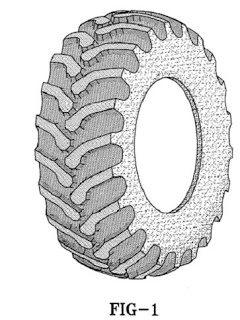 This rather conventional-seeming tractor tyre (sorry, "tire") was the subject of U.S. Design Patent No. 360,862, on which the proprietor attempted to get a preliminary (aka interlocutory aka interim) injunction in Titan Tire Corp. v. Case New Holland, Inc., No. 08-1078 (Fed. Cir. June 3, 3009), link here. They failed both at first instance and on appeal. To get an interlocutory injunction in the US requires a likelihood of success on the merits, and where the defendant has shown some reasonably persuasive prior art (which can't have been hard in this case) the plaintiff has to demonstrate that they will likely overcome it at trial - quite a high burden of proof.
Tags: injunction, interlocutory, preliminary, us, validity,
Perm-A-Link: https://www.marques.org/blogs/class99?XID=BHA45
US Designs - Validity post-Egyptian Goddess

The Federal Circuit reviewed their previous practice on assessing designs against prior art, which had required identification of a "primary" reference which could then be modified by a "secondary" reference to reach the design (Durling v. Spectrum Furniture Co., 101 F.3d 100, 103 (Fed. Cir. 1996)).
They commented that this tended to focus attention on the differences from the art, rather than the design as a whole, and that this was inconsistent with the analysis for infringement purposes post-Egyptian Goddess where the similar "point of novelty" test has been rejected (Egyptian Goddess, Inc. v. Swisa, 543 F.3d 665, 670-71 (Fed. Cir. 2008) (en banc). However, they heold that "it is not clear to what extent, if any, the doctrine applicable to obviousness should be modified to conform".
They also commented on the application of the KSR patent approach to obviousness (KSR International Co. v. Teleflex, Inc 550 U.S. 398 (2007)); this was “new and untested ground” and it was "not obvious that the Supreme Court necessarily intended to exclude design patents from the reach of KSR".
It is a shame that the Federal Circuit were unable or unwilling to give a clear ruling on applying the same "overall impression" test for both validity and infringement (as in the EU). Designs are fundamentally different to inventions, and there is no real logic to applying patent law such as KSR unmodified to take account of this. Whilst making the right kind of noises, this case leaves design invalidity in a state of flux.
Posted by: David Musker @ 13.23It is a shame that the Federal Circuit were unable or unwilling to give a clear ruling on applying the same "overall impression" test for both validity and infringement (as in the EU). Designs are fundamentally different to inventions, and there is no real logic to applying patent law such as KSR unmodified to take account of this. Whilst making the right kind of noises, this case leaves design invalidity in a state of flux.
Tags: injunction, interlocutory, preliminary, us, validity,
Perm-A-Link: https://www.marques.org/blogs/class99?XID=BHA45
MARQUES does not guarantee the accuracy of the information in this blog. The views are those of the individual contributors and do not necessarily reflect those of MARQUES. Seek professional advice before action on any information included here.
The Class 99 Archive

