
CLASS 99
The blog for design law, in Europe and worldwide. This weblog is written by a team of design experts and fans. To contribute, or join us, or for any other reason, email class99@marques.org.
Want to receive Class 99 by email?
Click here subscribe for free.
Click here subscribe for free.
Who we all are...
MONDAY, 19 NOVEMBER 2012
Out of sight - in the wall and in the Patent Office
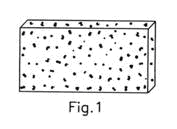 Some time ago we covered a decision of the Polish Supreme Administrative Court holding that the depicted speckly insulation block (the subject of Registered Community Design RCD 150917-0004 was not valid as it was a "component part of a complex product" not visible in "normal use" of the complex product under Art 4 CDR. OHIM's Invalidation Division took a parallel validity decision, coming to the opposite conclusion (or at least concluding that it was case not proven), in invalidation decision ICD 5353.
In Board of Appeal Decision R 1482/2009-3 TERMO ORGANIKA Sp. z.o.o. v Austrotherm GmbH, the Board admitted new evidence on that issue, and remitted the case back to the Invalidation Division for a new decision, which promises to be interesting. The former UK law held that buildings (other than portable ones) were not "articles" registrable as designs, which made sense on several grounds. Firstly, there was intended to be no overlap between designs and copyright and buildings were understood to be protectable as architectural works. Secondly, unlike the articles which are the subject of most designs, you can't import or export buildings - they tend to stay put. If, as I tend to think, the same is also true of "products" under the current EU law, then these building blocks are not "component parts" of any product at all. Even if they are, however, there are issues about whether they can be disassembled and replaced. Anything could, with enough brute force, be pulled out and replaced, so it will be interesting to have a decision on how much permanence is required in order to avoid the "not visible" exclusion.
However, a second interesting issue arose in the appeal, discussed in Alicante News on OHIM's website here. The cited prior art was a German Utility Model and it's Turkish priority document, filed but not granted before the date of the opposed RCD. Apparently, the drawings of German Utility Models are in the file and can be inspected after filing, and some information (e.g. classification) is available if anyone were interested in doing so.
On this point, the case makes an interesting comparison with the prior art considered in patent law. A good summary of the European position is in the recent EPO Board of Appeal test case T 1553/06-3.5.04 Public availability of documents on the World Wide Web/PHILIPS. According to the Board in that case, mere theoretical availability (e.g. a single unindexed, uncatalogued copy of a thesis in a library) is insufficient for disclosure, but where it is indexed or catalogued (as here), it matters not that only members of the public with no connection with the field saw it or indeed if no one saw it at all, provided that it could have been seen on request. This is probably also true these days in the US (see the MPEP here).
However, as Art 7 CDR excludes disclosures where
Tags: appeal, invalidation, Novelty, OHIM, Registered Community design, safeguart clause, state of the art,
Perm-A-Link: https://www.marques.org/blogs/class99?XID=BHA387
Out of sight - in the wall and in the Patent Office
In Board of Appeal Decision R 1482/2009-3 TERMO ORGANIKA Sp. z.o.o. v Austrotherm GmbH, the Board admitted new evidence on that issue, and remitted the case back to the Invalidation Division for a new decision, which promises to be interesting. The former UK law held that buildings (other than portable ones) were not "articles" registrable as designs, which made sense on several grounds. Firstly, there was intended to be no overlap between designs and copyright and buildings were understood to be protectable as architectural works. Secondly, unlike the articles which are the subject of most designs, you can't import or export buildings - they tend to stay put. If, as I tend to think, the same is also true of "products" under the current EU law, then these building blocks are not "component parts" of any product at all. Even if they are, however, there are issues about whether they can be disassembled and replaced. Anything could, with enough brute force, be pulled out and replaced, so it will be interesting to have a decision on how much permanence is required in order to avoid the "not visible" exclusion.
However, a second interesting issue arose in the appeal, discussed in Alicante News on OHIM's website here. The cited prior art was a German Utility Model and it's Turkish priority document, filed but not granted before the date of the opposed RCD. Apparently, the drawings of German Utility Models are in the file and can be inspected after filing, and some information (e.g. classification) is available if anyone were interested in doing so.
On this point, the case makes an interesting comparison with the prior art considered in patent law. A good summary of the European position is in the recent EPO Board of Appeal test case T 1553/06-3.5.04 Public availability of documents on the World Wide Web/PHILIPS. According to the Board in that case, mere theoretical availability (e.g. a single unindexed, uncatalogued copy of a thesis in a library) is insufficient for disclosure, but where it is indexed or catalogued (as here), it matters not that only members of the public with no connection with the field saw it or indeed if no one saw it at all, provided that it could have been seen on request. This is probably also true these days in the US (see the MPEP here).
However, as Art 7 CDR excludes disclosures where
"these events could not reasonably have become known in the normal course of business to the circles specialised in the sector concerned, operating within the Community",and as the opponent filed evidence from search companies that customers did not in fact routinely review the files of unpublished Utility Models, the Board held that the effort involved in ordering up the file coupled with the evidence that this was not routine practice meant that the disclosure was excluded from the state of the art. On the evidence, I think they were right and the first instance were wrong, as we said back in 2009. Posted by: David Musker @ 16.12
Tags: appeal, invalidation, Novelty, OHIM, Registered Community design, safeguart clause, state of the art,
Perm-A-Link: https://www.marques.org/blogs/class99?XID=BHA387
MARQUES does not guarantee the accuracy of the information in this blog. The views are those of the individual contributors and do not necessarily reflect those of MARQUES. Seek professional advice before action on any information included here.
The Class 99 Archive

