
CLASS 99
The blog for design law, in Europe and worldwide. This weblog is written by a team of design experts and fans. To contribute, or join us, or for any other reason, email class99@marques.org.
Want to receive Class 99 by email?
Click here subscribe for free.
Click here subscribe for free.
Who we all are...
MONDAY, 19 NOVEMBER 2012
LED shines a light on the underside of infringement
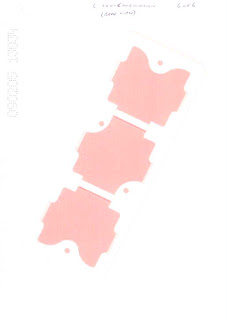 Some time ago we briefly commented on one aspect of the Australian appeal decision in LED Technologies v Elecspess, the first instance decision of which is discussed here. The same designs have been re-litigated against other defendants in LED Technologies v Roadvision, the first instance decision being reported at [2011] FCA 146 and this year's appeal at [2012] FCAFC 3. It is well worth a read, and European readers will find much of interest in view of the similarity between Australian and European design law.
The point of interest discussed here is the effect of parts of the design which are not visible in normal use. The registration in this case was for a vehicle indicator lamp assembly, and included rear views (depicted) which would not have been visible once the assembly was connected to a vehicle. The alleged infringement had a different rear view, and the question was how significant this difference should be. Naturally, the proprietor thought it should be downplayed, and submitted evidence that the alleged infringer marketed the product with only the front visible.
At both instances the Court held that the rear views should be taken into account. According to Besanko J.,
However, the approach of OHIM and the EU Courts is that the "informed user" is the end user (see Cases T-10/08 and T-11/08), and that differences which are not visible in normal use are inherently downplayed. See for example the General Court decision T 9/07 Communications Equipment:
For more discussion, see our earlier postings here, and here. Posted by: David Musker @ 17.42
Tags: australia, component, individual character, informed user, infringement, not visible,
Perm-A-Link: https://www.marques.org/blogs/class99?XID=BHA386
LED shines a light on the underside of infringement
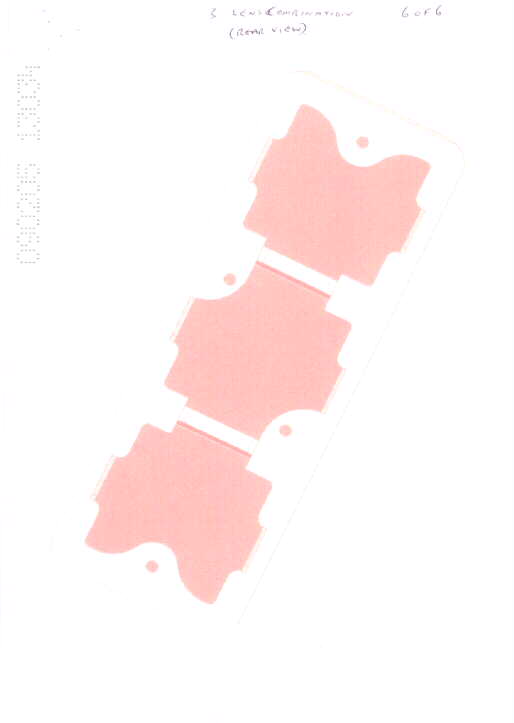
The point of interest discussed here is the effect of parts of the design which are not visible in normal use. The registration in this case was for a vehicle indicator lamp assembly, and included rear views (depicted) which would not have been visible once the assembly was connected to a vehicle. The alleged infringement had a different rear view, and the question was how significant this difference should be. Naturally, the proprietor thought it should be downplayed, and submitted evidence that the alleged infringer marketed the product with only the front visible.
At both instances the Court held that the rear views should be taken into account. According to Besanko J.,
"The trial judge did not identify a particular class of persons as constituting the informed user, and the informed user may be taken to include the wholesaler who buys for the purpose of on-selling the lights, the person who fits the lights and the ultimate consumer who uses the vehicles to which the lights are fitted. I did not understand the appellant to submit that the trial judge had erred in his identification of the informed user. The difference in the back of the lights is a significantly different visual feature. It seems to me that in terms of infringement, one of the most significant matters is that the registered designs appeared in a crowded field of prior art. As the trial judge noted, many of the features of similarity between the registered designs and the respondents’ lights were features that were common in the prior art. Even if less weight is placed on the difference in the underside of the base it is still a relevant visual feature and, with the other features identified by the trial judge, leads me to conclude that the trial judge did not err in deciding that the design embodied in the respondents’ lights was not substantially similar in overall impression to the registered designs."These features, being features of a component not visible in normal use by the end user, would be ignored for validity purposes under Art 4 CDR, but are not "crossed out" for infringement purposes. Thus, would the case have been decided differently in Europe? Not in the UK, at any rate. According to Judge Birss in Samsung v Apple [2012] EWHC 1882 (Pat),
"They [the design and the alleged infringement] look similar because they both have the same front screen. It stands out. However to the informed user (which at that stage I was not) these screens do not stand out to anything like the same extent. The front view of the Apple design takes its place amongst its kindred prior art. There is a clear family resemblance between the front of the Apple design and other members of that family (Flatron, Bloomberg 1 and 2, Ozolins, Showbox, Wacom). They are not identical to each other but they form a family. There are differences all over these products but the biggest differences between these various family members are at the back and sides. The user who is particularly observant and is informed about the design corpus reacts to the Apple design by recognising the front view as one of a familiar type. From the front both the Apple design and the Samsung tablets look like members of the same, pre-existing family. As a result, the significance of that similarity overall is much reduced and the informed user's attention to the differences at the back and sides will be enhanced considerably."He was upheld in this by the Court of Appeal.
However, the approach of OHIM and the EU Courts is that the "informed user" is the end user (see Cases T-10/08 and T-11/08), and that differences which are not visible in normal use are inherently downplayed. See for example the General Court decision T 9/07 Communications Equipment:
"... when the conference unit is in use, the speaker is raised in order to be able to fulfil its function. Consequently, the decoration at issue is on the back of the device and therefore outside the user’s immediate field of vision, which means that it will not have any major impact on the user’s perception. ...It should also be observed that, contrary to what the applicant claims, taking into account the reduced visibility of the lid of the speaker is not contrary to the rule that the overall impression produced by the contested design on the informed user should be assessed. That impression must necessarily be determined also in the light of the manner in which the product at issue is used, in particular on the basis of the handling to which it is normally subject on that occasion."The CJEU in Pepsico declined to criticise the General Court for having considered the design "in particular from above" rather than focusing on the profile. As an aside, via Hiroyuki Nakagawa's Japan Group Report, we learned at the recent APAA conference of Japanese Case No. Heisei 21 (wa) 13219 Decision of December 27, 2011, Tokyo district court, concerning a "steam mop" design, also seems to have given highest weight to the features which were visible during end use by the user of the mop.
For more discussion, see our earlier postings here, and here. Posted by: David Musker @ 17.42
Tags: australia, component, individual character, informed user, infringement, not visible,
Perm-A-Link: https://www.marques.org/blogs/class99?XID=BHA386
MARQUES does not guarantee the accuracy of the information in this blog. The views are those of the individual contributors and do not necessarily reflect those of MARQUES. Seek professional advice before action on any information included here.
The Class 99 Archive

