
CLASS 99
The blog for design law, in Europe and worldwide. This weblog is written by a team of design experts and fans. To contribute, or join us, or for any other reason, email class99@marques.org.
Want to receive Class 99 by email?
Click here subscribe for free.
Click here subscribe for free.
Who we all are...
MONDAY, 31 OCTOBER 2011
Caravan cover - no cover-up
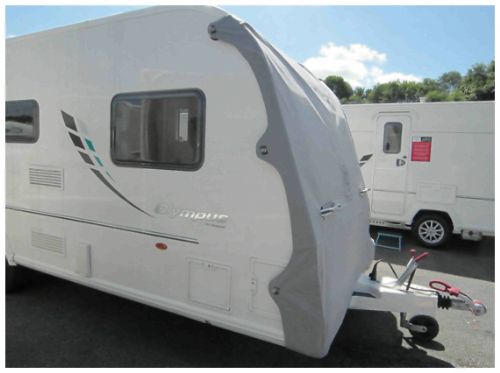 We are pleased to report what may be the first judgment of Richard Meade QC sitting as a Deputy Patents County Court judge, in Pro-Tec Covers v Specialised Covers [2011] EWPCC 23. Quite a long decision, but it seems that the parties put a lot into the case, which ran for three days.
The case concerned covers for the front of caravans, and involved an ex-employee, some keen caravanners and a certain amount of bad blood. The major problem faced by the claimant was that, although they had shown access and similarity, that is nowadays not enough to get you to proof of copying because in a functional design, similarities can arise out of necessity as well as out of copying. In this case, according to Mr Meade, "the allegation is of a concerted campaign of copying by at least four people, followed by a concerted campaign of lying about it and covering it up. I would only accept such an allegation if there were compelling evidence in favour of it." And, in his view, there was not.
As a practical matter, it is hard to know how one would ever be able to pin down a really unscrupulous copyist under these circumstances, for as he says, "If it were true that the Defendants and Mr Lord made a conscious plan to copy which they followed through and then concealed then one would not expect any evidence of actual access to survive." If access and similarity are insufficient, and the defendant has covered his design trail, what is left to the plaintiff?
The case resurrects an interesting debate on the scope of the UK Unregistered Design Right "must fit" exclusion (CDPA s. 213(3)(b)(i)), which might also be applicable to the corresponding provisions of the EU Community Design Regulation and the Registered Designs Act. Put simply, the question is: if all the component parts of a complex product are excluded from protection as being "must fit", can the whole nonetheless be protectable? The Court held not in Baby Dan v. Brevi [1999] FSR 377. However, as Mr Meade notes, "Baby Dan has received some adverse comment in the textbooks (e.g. Laddie, Prescott and Vitoria, 4th Ed. paragraph 45.35), and has been suggested to be inconsistent with Electronic Techniques (Anglia) Limited v. Critchley [1997] FSR 401." The question was left undecided in Ultraframe v. Eurocell [2005] RPC 36, [2005] EWCA (Civ) 761 and, having not heard full argument on it, Mr Meade left it undecided also.
But is it really still an undecided point? It appears to have been dealt with, as clearly and succinctly as one would expect, by Sir Robin Jacob LJ in Dyson v Qualtex [2006] EWCA Civ 166 at paras 20-21:
"Before going to the detailed points, it makes sense to consider Mr Carr's opening, general point – one by way of reductio ad absurdum. He submitted that if Mr Arnold were right about his construction of "must-match" it would be open to a third party to produce all the parts which go to make up the external appearance of the machine. And if he were right on his construction of "must-fit" the same would apply to all the working parts. So, if Mr Arnold were right, people would simply be able to copy the whole machine itself. That is absurd and cannot be so. I do not think this general argument assists. One answer (there are others) is because a separate UDR will subsist in that aspect consisting of the appearance of the whole article, it does not matter if none subsists in the individual parts. That UDR is not a feature of shape which is dependent on the appearance of anything."
That must surely be right in logic. Each part may dictate features of another, but the whole is not dictated by the parts. But does that defeat the object of the provisions, or are they aimed only at the parts per se?
Finally, an interesting point on cross-examination: to what extent can you surprise a witness with cross-examination documents in the UK? The element of surprise has largely been removed from UK patent litigation. However, in an unregistered design case, it is not uncommon (at least at the beginning of the case) for defendants to be economical with the actualité, and if it is the claimant's case that they are lying, then they may need to be able to trip up a lying witness with no notice in advance, as was reluctantly but perhaps tacitly accepted by the judge in this case:
"It would perhaps have been fairer and more efficient to provide the materials in the cross-examination bundle to Mr Proctor in advance in the way now common in patent actions, but I think the degree of surprise was modest and Mr Proctor did not appear thrown by it."
Posted by: David Musker @ 16.08
Tags: cross examination, litigation uk, must fit, UK Unregistered Design Right,
Perm-A-Link: https://www.marques.org/blogs/class99?XID=BHA280
Caravan cover - no cover-up
The case concerned covers for the front of caravans, and involved an ex-employee, some keen caravanners and a certain amount of bad blood. The major problem faced by the claimant was that, although they had shown access and similarity, that is nowadays not enough to get you to proof of copying because in a functional design, similarities can arise out of necessity as well as out of copying. In this case, according to Mr Meade, "the allegation is of a concerted campaign of copying by at least four people, followed by a concerted campaign of lying about it and covering it up. I would only accept such an allegation if there were compelling evidence in favour of it." And, in his view, there was not.
As a practical matter, it is hard to know how one would ever be able to pin down a really unscrupulous copyist under these circumstances, for as he says, "If it were true that the Defendants and Mr Lord made a conscious plan to copy which they followed through and then concealed then one would not expect any evidence of actual access to survive." If access and similarity are insufficient, and the defendant has covered his design trail, what is left to the plaintiff?
The case resurrects an interesting debate on the scope of the UK Unregistered Design Right "must fit" exclusion (CDPA s. 213(3)(b)(i)), which might also be applicable to the corresponding provisions of the EU Community Design Regulation and the Registered Designs Act. Put simply, the question is: if all the component parts of a complex product are excluded from protection as being "must fit", can the whole nonetheless be protectable? The Court held not in Baby Dan v. Brevi [1999] FSR 377. However, as Mr Meade notes, "Baby Dan has received some adverse comment in the textbooks (e.g. Laddie, Prescott and Vitoria, 4th Ed. paragraph 45.35), and has been suggested to be inconsistent with Electronic Techniques (Anglia) Limited v. Critchley [1997] FSR 401." The question was left undecided in Ultraframe v. Eurocell [2005] RPC 36, [2005] EWCA (Civ) 761 and, having not heard full argument on it, Mr Meade left it undecided also.
But is it really still an undecided point? It appears to have been dealt with, as clearly and succinctly as one would expect, by Sir Robin Jacob LJ in Dyson v Qualtex [2006] EWCA Civ 166 at paras 20-21:
"Before going to the detailed points, it makes sense to consider Mr Carr's opening, general point – one by way of reductio ad absurdum. He submitted that if Mr Arnold were right about his construction of "must-match" it would be open to a third party to produce all the parts which go to make up the external appearance of the machine. And if he were right on his construction of "must-fit" the same would apply to all the working parts. So, if Mr Arnold were right, people would simply be able to copy the whole machine itself. That is absurd and cannot be so. I do not think this general argument assists. One answer (there are others) is because a separate UDR will subsist in that aspect consisting of the appearance of the whole article, it does not matter if none subsists in the individual parts. That UDR is not a feature of shape which is dependent on the appearance of anything."
That must surely be right in logic. Each part may dictate features of another, but the whole is not dictated by the parts. But does that defeat the object of the provisions, or are they aimed only at the parts per se?
Finally, an interesting point on cross-examination: to what extent can you surprise a witness with cross-examination documents in the UK? The element of surprise has largely been removed from UK patent litigation. However, in an unregistered design case, it is not uncommon (at least at the beginning of the case) for defendants to be economical with the actualité, and if it is the claimant's case that they are lying, then they may need to be able to trip up a lying witness with no notice in advance, as was reluctantly but perhaps tacitly accepted by the judge in this case:
| "Perhaps this will refresh your memory! James Thurber, 1935 |
Tags: cross examination, litigation uk, must fit, UK Unregistered Design Right,
Perm-A-Link: https://www.marques.org/blogs/class99?XID=BHA280
MARQUES does not guarantee the accuracy of the information in this blog. The views are those of the individual contributors and do not necessarily reflect those of MARQUES. Seek professional advice before action on any information included here.
The Class 99 Archive

