
CLASS 99
The blog for design law, in Europe and worldwide. This weblog is written by a team of design experts and fans. To contribute, or join us, or for any other reason, email class99@marques.org.
Want to receive Class 99 by email?
Click here subscribe for free.
Click here subscribe for free.
Who we all are...
WEDNESDAY, 26 JANUARY 2011
Take that expression off your face - if you want to keep your design
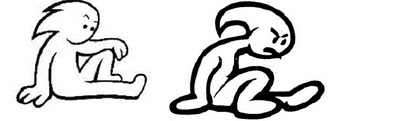 The General Court has taken its fourth substantive Community Design appeal decision, Baena Grupo v OHIM T-513/09, on these two rather angry gnomes (or "lutins grognant"as the French text has it) - here, in French (Spanish also available).
The case has had a rather erratic history. The citation, on the right, is a published Community Trade Mark (CTM 1312651), and at first instance the Community design (RCD 426895-0002, on the left) was invalidated over the citation considered as a prior right, as being a mis-use (i.e. an infringement) of the trade mark.
The Appeal Board overturned that in Decision R 1323/2008-3 (here, in Spanish), ruling that "use" of an earlier mark in this context did not cover use of something similar (in contrast to the well-known MIDAS decision?) but held it invalid nonetheless, this time on the basis of lack of individual character over the citation considered as prior art.
What did the General Court say? They reversed the Board of Appeal, despite what one might reasonably think to be the overall similarity between the two. The twin bases were: firstly, the identity of the informed user - a teenager or a younger child (the latter was quite important), and secondly, the importance of the angry facial expression (and perhaps pose also) in the citation, as being the thing which would stick in the memory of that informed user.
From a UK point of view, it therefore makes an interesting contrast with the approach in Procter & Gamble v Reckitt Benckiser, firstly because this "informed user" is not stated to be attentive or particularly interested in design issues (and is hence pretty undiscriminating), and secondly because of what seems to be quite a strong role for the doctrine of "imperfect recollection", held in P&G to have lesser significance in design cases.
As with several earlier General Court and OHIM decisions, the citation was taken "as a whole" and no thought was given to comparing like with like - since the design has no mouth, surely the fair comparison is to compare that part of the citation without a mouth to the design? In the context of an infringement, the implication of the General Court's approach is that one could take the entirety of a design, add something and thus avoid infringement. Is that right? What do you think, dear readers? Posted by: David Musker @ 16.09
Tags: appeal, expression, general court, imperfect recollection, invalidation, logo, Registered Community design, trade mark,
Perm-A-Link: https://www.marques.org/blogs/class99?XID=BHA206
Take that expression off your face - if you want to keep your design
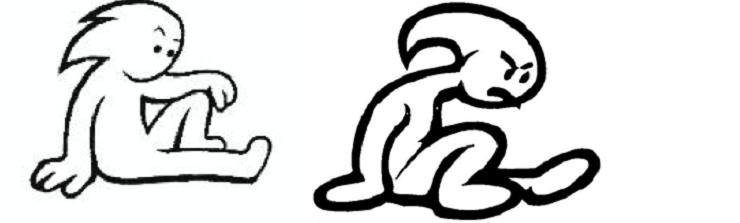 The General Court has taken its fourth substantive Community Design appeal decision, Baena Grupo v OHIM T-513/09, on these two rather angry gnomes (or "lutins grognant"as the French text has it) - here, in French (Spanish also available).
The case has had a rather erratic history. The citation, on the right, is a published Community Trade Mark (CTM 1312651), and at first instance the Community design (RCD 426895-0002, on the left) was invalidated over the citation considered as a prior right, as being a mis-use (i.e. an infringement) of the trade mark.
The Appeal Board overturned that in Decision R 1323/2008-3 (here, in Spanish), ruling that "use" of an earlier mark in this context did not cover use of something similar (in contrast to the well-known MIDAS decision?) but held it invalid nonetheless, this time on the basis of lack of individual character over the citation considered as prior art.
What did the General Court say? They reversed the Board of Appeal, despite what one might reasonably think to be the overall similarity between the two. The twin bases were: firstly, the identity of the informed user - a teenager or a younger child (the latter was quite important), and secondly, the importance of the angry facial expression (and perhaps pose also) in the citation, as being the thing which would stick in the memory of that informed user.
From a UK point of view, it therefore makes an interesting contrast with the approach in Procter & Gamble v Reckitt Benckiser, firstly because this "informed user" is not stated to be attentive or particularly interested in design issues (and is hence pretty undiscriminating), and secondly because of what seems to be quite a strong role for the doctrine of "imperfect recollection", held in P&G to have lesser significance in design cases.
As with several earlier General Court and OHIM decisions, the citation was taken "as a whole" and no thought was given to comparing like with like - since the design has no mouth, surely the fair comparison is to compare that part of the citation without a mouth to the design? In the context of an infringement, the implication of the General Court's approach is that one could take the entirety of a design, add something and thus avoid infringement. Is that right? What do you think, dear readers? Posted by: David Musker @ 16.09
Tags: appeal, expression, general court, imperfect recollection, invalidation, logo, Registered Community design, trade mark,
Perm-A-Link: https://www.marques.org/blogs/class99?XID=BHA206
MARQUES does not guarantee the accuracy of the information in this blog. The views are those of the individual contributors and do not necessarily reflect those of MARQUES. Seek professional advice before action on any information included here.
The Class 99 Archive

