
Now in its twelfth year, Class 46 is dedicated to European trade mark law and practice. This weblog is written by a team of enthusiasts who want to spread the word and share their thoughts with others.
Click here subscribe for free.
Who we all are...
Book review: Exhaustion of Intellectual Property Rights
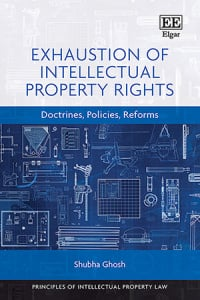 Charlotte Duly of the MARQUES Education Team reviews “Exhaustion of Intellectual Property Rights” by Professor Shubha Ghosh (published by Edward Elgar Publishing, priced £95 for the hardback and available here).
This book reviews the principle of exhaustion of IP rights on a global basis, including the approach in the USA, EU and other territories. The book splits the various IP rights into separate chapters, looking at how exhaustion is applied in the fields of patents, copyright, trade marks and trade secrets.
Exhaustion is a hot topic in the United Kingdom following the departure from the EU (Brexit).
Generally, the EU principle of exhaustion means that once a product has been placed on the market in an EU member state with the rights holder’s consent, the rights holder cannot use their IP rights to prevent the resale or free movement within the EU. Following Brexit, the UK had to consider their position regarding exhaustion and opted for a unique UK+ regime, which the UK government confirmed would be maintained earlier this year.
The UK’s position essentially ensures that IP rights are exhausted in the UK when a good is placed on the market in either the UK or the European Economic Area (EEA). However, this is not reciprocated and now the UK is outside the of the EU it does not have the benefit of the EU exhaustion principle, meaning the flow of goods from the UK to the EU could be restricted by IP rights.
Globally, the position is, unsurprisingly, not uniform and this book offers a clear and comprehensive explanation of how exhaustion applies to the various IP rights across a number of territories.
In recent years, key trends and issues have emerged across sectors, in particular involving the environment and advances in technology. This book contains a chapter dedicated to upcycling and renewal and considers how exhaustion may apply beyond the first-sale doctrine to allow for reuse.
Digital exhaustion is also discussed and is likely to be an ever-growing topic of interest across the globe. Whilst technological measures may be used in the digital sphere to make the resale or reuse of rights difficult or impossible, as there are further advances in technology the opportunities to exploit rights will evolve and this chapter provides food for thought.
This book is thought provoking and will be embraced by students and IP scholars. It is also a fascinating source of information for those working in the IP field, such as lawyers and rights holders, to consider the boundaries and evolution of exhaustion.
The picture shows the cover of 'Exhaustion of Intellectual Property Rights'
Posted by: Blog Administrator @ 11.10Tags: Book review, Education Team, exhaustion,


 Sharing on Social Media? Use the link below...
Perm-A-Link: https://www.marques.org/blogs/class46?XID=BHA5400


