
Now in its twelfth year, Class 46 is dedicated to European trade mark law and practice. This weblog is written by a team of enthusiasts who want to spread the word and share their thoughts with others.
Click here subscribe for free.
Who we all are...
MARQUES Month: update on week two
How can brand owners avoid being out-smarted by tech-savvy counterfeiters? That was the topic of the third panel session of MARQUES Month, which took place last Tuesday.
During the webinar on “Technology in tracking counterfeiters” speakers discussed the technological tools available to brand owners, and how these can be deployed. They also shared tips on how to prioritise threats and work with law enforcement.
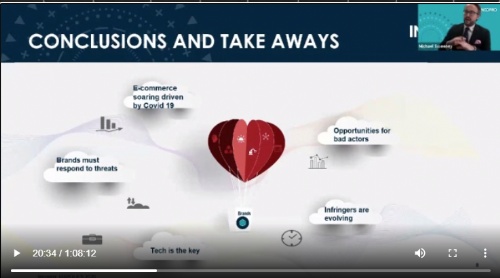 Michael Sweeney of Incopro started by noting that the ICC estimates that counterfeiting and piracy will be worth $4.2 trillion by 2022 and that brand owner can often feel overwhelmed, outnumbered and that they have a thankless task.
But he said that by following the “Discover-Prioritise-Act” formula, brand owners can take a proactive approach that focuses on the biggest threats. He provided a case study of a toy company that had increased sales by 130% in nine months by tackling its counterfeiting problem.
Emma-Jane Tritton of Richemont provided more detail on how technology can help identify “clusters” of the biggest threats, which can then be assessed based on factors such as location, pricing and website status. She shared a case study from China where investigation followed by legal action had led to a couple who were selling counterfeits on Taobao and WeChat both being fined and imprisoned.
While the role of data analysis is vital, said Emma-Jane, “you still need the human analysis to make sense of trends” and to build cooperation beyond notice and take-down letters.
In her presentation, Anja Franke of Grunecker summarised recent developments to fight counterfeits in Europe including European Commission initiatives, case law on blocking injunctions, the Blockathon and Europol and Interpol initiatives (In Our Sites and Pangea respectively).
Summing up, moderator Claire Lehr of EIP said that brand owners should not feel “outsmarted” given the technology now available to help with enforcement.
Brand owners and the Madrid System
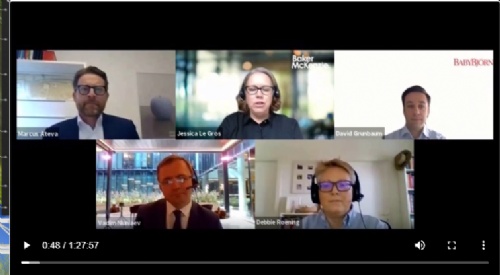 In the second webinar held last week, speakers discussed practical issues concerning the Madrid System, and took questions from the audience (“WIPO: Corporate Counsel and the Madrid Protocol”).
Debbie Roenning of WIPO said that the shift to remote working “has worked surprisingly well” and provided updates on demand for filings, which she described as “erratic”.
David Grunbaum of BabyBjorn and Vadim Niuniaev of Gazprom shared insights from brand owners that use the Madrid System, including on the impact of COVID-19 on their business, trade mark filing strategies and strategies for the Madrid System.
Marcus Ateva of MarLaw added the perspective of a lawyer in private practice and the session was moderated by Jessica Le Gros of Baker McKenzie.
Both these webinars, as well as all the previous events in MARQUES Month, are available for registrants to view again in the auditorium. Read a summary of the first week’s webinars in this Class 46 blog post.
Coming up this week
There are two more MARQUES Month sessions this week. “Music and new technology” takes place at 13.30 BST/14.30 CEST today (Tuesday) and on Friday there is a workshop on technical functionality, also at 13.30 BST/14.30 CEST.
If you are registered for these events, you can join them live (and engage in the Q&A) or watch the recordings from the day after broadcast via the MARQUES Month lobby.
Posted by: Blog Administrator @ 10.39Tags: MARQUES Month, WIPO, Madrid System, ,


 Sharing on Social Media? Use the link below...
Perm-A-Link: https://www.marques.org/blogs/class46?XID=BHA4909


