
Now in its twelfth year, Class 46 is dedicated to European trade mark law and practice. This weblog is written by a team of enthusiasts who want to spread the word and share their thoughts with others.
Click here subscribe for free.
Who we all are...
BEPS, DEMPE and the Double Irish – Part 6 of Annual Conference
“Tax is political,” said Lodewijk Berger of Jones Day in The Netherlands during Part 6 of this year’s Annual Conference in Dublin, which asked: Do tax havens have a future? “Who gets to tax what portion of the profits of a multinational enterprise? It doesn’t get more political than that!” explained Lodewijk. The panel was especially topical given the success of Ireland in implementing favourable tax regimes, and the controversy that has generated.
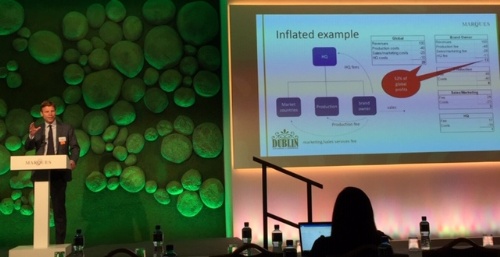 Lodewijk said that the arm’s length principle, which is widely applied, is a good principle but is not perfect. Today, allocation of profits is particularly sensitive where IP is significant for the company and there are different corporate entities in different countries. Corporate tax rates can vary substantially, from zero in the Cayman Islands to more than 30 percent in countries such as France. And some tax structures have been created specifically to attract international enterprises, such as the Double Irish which offers preferential rates to some companies.
Tax reforms
This means that if a significant portion of global profits are attributable to IP, it matters where the IP is located. “That impacts how a multinational enterprise is organised,” said Lodewijk. But he added that major tax reforms are now underway. In the United States, President Trump has lowered the corporate tax rate. There is a significant effort by the OECD to overhaul international standards on allocation of taxation rights (so-called BEPS), and the EU has agreed minimal standards for all Member States. Ireland has agreed to phase out the Double Irish structure, and the Netherlands and Switzerland have also tightened up their rules. The impact of these initiatives is more transparency and crackdowns on abuses.
 “There’s nothing new in tax and IP planning,” said Peter Vale of Grant Thornton in Ireland. There has already been a shift away from offshore tax havens following public concern, he said, adding: “That means that groups are going to pay more tax.” The new rules mean there is closer alignment between the “substance” of your business and taxable profits, so it will be increasingly rare to have the substance and the IP kept separate. BEPS has introduced the concept of “DEMPE” to help define substance: Development, Enhancement, Maintenance, Protection and Exploitation of intangibles.
While much progress has been made, Peter said questions remain over profit allocation once the location of the IP has been finalised. He explained that a future drive towards location of consumers, based on customer data for example, could alter existing profit allocation models. Lodewijk added that another developing issue is digital services and BEPS 2.0, which has two pillars: change rules to give market countries a bigger piece of the cake and a global minimum tax standard.
Questions addressed in the discussion, which was moderated by Patricia McGovern of DFMG Solicitors in Ireland, included whether the EU risks becoming less competitive compared to other regions; what approach the UK might take after Brexit; the interaction between tax and state aid; and how DEMPE will be implemented in practice. The speakers concluded that tax havens do have a future, but maybe not for tax purposes.
Posted by: Blog Administrator @ 12.17Tags: Annual Conference, OECD, BEPS, DEMPE, tax havens,


 Sharing on Social Media? Use the link below...
Perm-A-Link: https://www.marques.org/blogs/class46?XID=BHA4785


