
Now in its twelfth year, Class 46 is dedicated to European trade mark law and practice. This weblog is written by a team of enthusiasts who want to spread the word and share their thoughts with others.
Click here subscribe for free.
Who we all are...
Lessons from the T2 case in China
|
Key takeaways
|
A recent case concerning the T2 brand confirms that overseas brand equity built through cross-border commerce, digital engagement and consumer recognition can receive meaningful protection in China, even before a brand has fully established a physical retail presence in China. By Yun Chen, Nadine Archer and Michael Rorai.
Background
This dispute concerned the Australian tea brand T2 and its associated IP rights.
The plaintiffs included its creator, an Australian Company Tea Too Pty Ltd (TEA TOO) and the former owner of the T2 trade mark. They brought legal proceedings against several local entities that were using the signs TEA TOO and 茶二 (CHA’ER, the Chinese equivalent of “Tea Too”) in China.
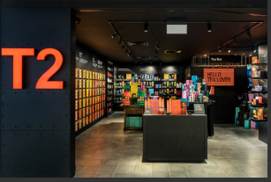
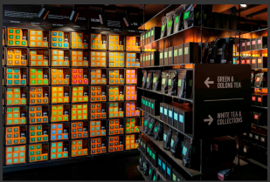
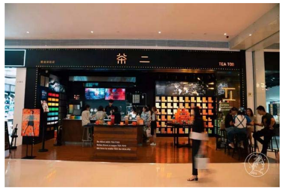
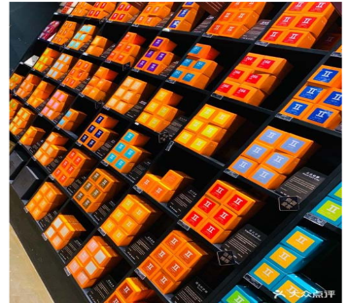
The plaintiffs alleged that the defendants had operated a tea brand under CHA’ER in Chinese, which was highly similar to T2, and had replicated key elements of the T2 brand’s overall trade dress through their corporate names, storefront decorations, product packaging and promotional materials. Notably, the storefront decorations included photographs of Tea Too’s employees.
The plaintiffs contended that these activities were intended to create an association with the T2 brand and to take unfair advantage of the goodwill and reputation it had built up over time.
The decision
The Chinese courts held at first instance and on appeal that the defendants’ use of TEA TOO and CHA’ER in Chinese, together with similar storefronts, packaging and promotional materials, constituted unfair competition.
The courts ordered the defendants to stop using the infringing signs and corporate names, remove infringing storefront materials and promotional materials, destroy relevant infringing items, eliminate the adverse effects of their conduct, and pay damages.
Five practical lessons for brand owners
Cross-border reputation can be recognised in China
 |
 |
| Plaintiff’s use |
After reviewing evidence showing the global development of the T2 brand, Chinese consumer discussions on e-commerce and social media platforms, media coverage and prior findings of the CNIPA, the courts concluded that the T2 brand and trade marks possessed substantial distinctiveness and enjoyed a relatively high degree of recognition within the relevant market in China.
Importantly, the Courts recognised that in today’s interconnected commercial environment, brand reputation no longer depends solely on physical operations within a particular territory. Cross-border e-commerce, digital marketing, social media engagement and international travel may all contribute to the establishment of goodwill and consumer recognition in China.
The courts also noted that the Defendants themselves had repeatedly suggested in their marketing materials that they had a business relationship with T2. These representations supported the conclusion that the T2 brand had already acquired significant commercial influence among Chinese consumers.
The ruling confirms that brand equity built through genuine consumer engagement does not stop at a country’s border. T2 had cultivated a real and measurable following among Chinese consumers through social media, cross-border e-commerce and international travel, well before operating physical retail locations in China.
Trade mark registration is not a shield for bad-faith conduct
 |
 |
| Defendant’s infringing use |
The defendants argued that they owned registered trade marks including CHA’ER in Chinese and therefore possessed a legitimate legal basis for using the disputed signs.
The courts rejected this argument, emphasising that trade mark registration addresses only the registrability of a mark. It does not automatically legitimise every subsequent act of use.
In this case, the courts found that TEA TOO corresponded phonetically to T2, while CHA’ER in Chinese represented its direct Chinese-language equivalent.
The court concluded that the registrations and subsequent use of the infringing signs formed part of a broader strategy to benefit from the goodwill associated with the T2 brand.
For overseas brands entering the Chinese market, this case highlights the importance of adopting a proactive trade mark filing and enforcement strategies at an early stage.
Joint enforcement by entities helps to enforce complementary interests together
The courts recognised that both the brand founder and operator, TEA TOO, and the related trade mark owner possessed direct and legitimate interests in protecting the T2 brand. Although one entity operated the brand while another held the trade mark registrations, both suffered harm arising from consumer confusion, loss of goodwill and unfair commercial competition.
They also held that trade mark infringement and unfair competition claims often arise from the same underlying conduct and therefore may be addressed efficiently in a single action.
Protection can extend to overall brand identity and trade dress
The court also took account of the replication of T2’s distinctive storefront appearance from actual T2 advertising materials, store décor and retail presentation, recognising that the look and feel of a retail environment can form an important part of a brand’s overall commercial identity where it contributes to consumer recognition and association.
The Court concluded that these activities collectively created a misleading association with the T2 brand and constituted acts of confusion and false commercial promotion under Chinese law.
Systematic bad-faith copying can lead to meaningful remedies
In determining liability and remedies, the court considered factors including the duration of the infringement, the scale of the defendants’ business operations, the commercial benefits derived from the infringing conduct and the market influence of the T2 brand.
Based on unfair competition, the courts ordered the defendants to stop using the infringing signs and corporate names, remove infringing storefront elements and promotional materials, destroy relevant infringing items and eliminate the adverse effects of their conduct.
The decision sends a strong signal that systematic and bad-faith attempts to free-ride on the reputation and goodwill of established brands may result in substantial legal and financial consequences.
Strategic implications for overseas brand owners
Overseas brand owners should consider filing early in China, monitoring third-party filings and market activity, preserving evidence of China-facing reputation, and documenting consumer engagement through e-commerce, social media, travel retail and other cross-border channels.
The case also underlines the value of taking a coordinated approach to enforcement where different group entities hold operational, goodwill and trade mark ownership interests.
Successful enforcement in China may depend not only on securing local registrations, but also on telling a clear, evidence-backed story about the brand’s reputation, consumer recognition and commercial journey.
Yun Chen is a Partner of Baker McKenzie FenXun; Nadine Archer is Senior Trade Marks Associate, Baker McKenzie London and Michel Rorai is former General Counsel Lipton Teas & Infusions Ltd, Partner at Legaltree and a member of the MARQUES IAM Team. Yun was local attorney, Nadine was coordinating global attorney and Michel was in-house counsel for Lipton in this case. Photos reproduced with permission
Posted by: Blog Administrator @ 08.11Tags: T2, Tea Too, China, ,


 Sharing on Social Media? Use the link below...
Perm-A-Link: https://www.marques.org/blogs/class46?XID=BHA5493
The 24th Madrid Working Group Session
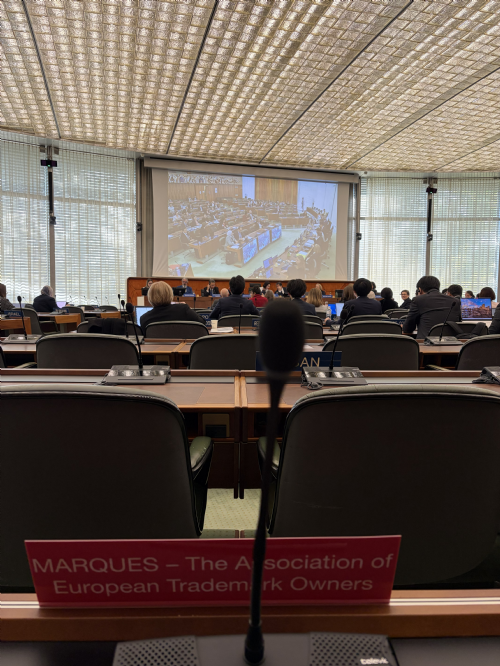
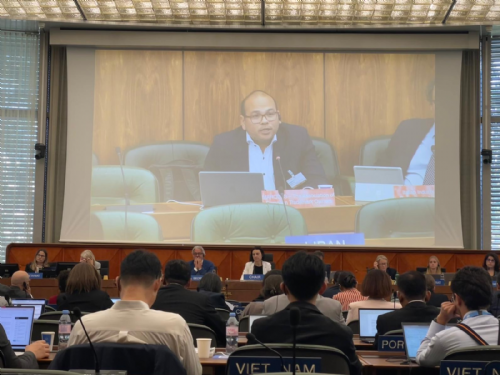 The 24th Session of the Working Group on the Legal Development of the Madrid System for the International Registration of Marks was held in Geneva from 5 to 9 October 2026.
Members of the MARQUES International Trade Mark Law and Practice Team (Gavin Stenton, Paola Tessarolo, Jessica Le Gros, Tove Graulund, Robert Rauther, Manuela Bruscolini, Joseph Sarmiento and Igor Alfiorov) attended the session remotely and in-person. They summarise the key decisions and discussions.
Continued discussions regarding the proposed introduction of a requirement for Contracting Parties to issue national or regional registration/renewal certificates and indicate certain relevant dates (namely, the date on which protection was granted as well as the date from which the use requirement starts) in Statements of Grant of Protection
The Working Group discussed these significant topics in considerable detail, having regard to the findings of the survey that the International Bureau (IB) had conducted on the need for and practical advantages of national or regional certificates.
Although many delegations, in particular MARQUES and other user organisations, expressed strong support for these material improvements, a number of delegations raised queries and practical concerns that require further elaboration and clarification.
Moving forward, the IB has been tasked with preparing a new document that provides the necessary elaboration and clarification, and proposes further amendments/refinements to the Regulations where appropriate.
Continued discussions regarding Option A of the proposal by the delegation of Moldova
Discussions continued in respect of the Republic of Moldova’s proposed amendments to the Regulations that would allow Contracting Parties to certify international applications filed by two or more applicants who jointly own the basic application/registration, when only one of them has a qualifying connection with the Contracting Party of the Office of origin, and the other has a qualifying connection with a distinct Contracting Party.
Following a lack of consensus, discussions on this proposal will continue in the 25th Session, and the IB has been tasked with preparing proposed amendments to the Regulations reflecting the discussions that took place.
 Continued discussions regarding the proposal by the delegation of the United Kingdom
Further discussions took place regarding the UK’s proposal that primarily aims to enhance user experience of the Madrid System, including the possible introduction of partial renewal of IRs (vacating the current need for partial renunciation prior to renewal), a centralised filing procedure for replacement via the IB and the faster allocation of IR numbers, particularly in the context of adding subsequent designations to pending IR applications where an IR number is yet to be generated.
Regarding partial renewal, delegations agreed in principle with the practical approach put forward by the IB whereby holders would be able, in the context of renewal, to request the cancellation or limitation of entire designations and potentially whole classes of goods and services.
The IB has been tasked with undertaking the necessary technical and operational work to implement the agreed approach on partial renewal, to provide further information on its practical operation, and to report on progress at the 25th Session Roundtable.
Regarding centralised replacement and the faster allocation of IR numbers (or use of the IB's Unique Reference Number), while delegations supported further consideration of the proposals, they also raised legal, procedural, operational, technical and practical questions and concerns requiring additional consideration and investigation that the IB has been tasked with conducting and then reporting back on in a comprehensive document at the 25th Session.
Dependency
In the continued absence of consensus, the Working Group agreed to continue discussions at the 25th Session.
Possible introduction of new languages
The proposals to introduce new official languages into the system, including Chinese, Russian, Arabic, Japanese, Portuguese and German, continued to be discussed in light of further studies and research conducted by the IB.
The Working Group continued to highlight the need to promote multilingualism and inclusivity while balancing feasibility and costs.
Discussions will continue during the 25th Session.
Photos provided by Team member Joseph Sarmiento
Posted by: Blog Administrator @ 14.13Tags: Madrid System, WIPO, Working Group,
Sharing on Social Media? Use the link below...Perm-A-Link: https://www.marques.org/blogs/class46?XID=BHA5492
Practical tips for Madrid System
 WIPO has published a five strategic guides to the strategic use of the Madrid System.
The five guides, which WIPO calls “cheat sheets”, cover:
- Choosing your office of origin strategically
- Choosing where to protect your mark
- Leveraging Madrid System digital tools
- Managing international trademark registrations
- Renewing international trademark registrations
They can be downloaded from the WIPO website here.
According to WIPO: “Whether you're filing your first international trademark application or managing a growing portfolio, these cheat sheets offer practical, strategic guidance to help you make decisions at every stage of your Madrid System journey – and avoid costly mistakes along the way.”
Posted by: Blog Administrator @ 16.41Tags: Madrid System, WIPO, cheat sheets,
Sharing on Social Media? Use the link below...Perm-A-Link: https://www.marques.org/blogs/class46?XID=BHA5491
Booking open for Luxury and Famous Brands Symposium
 MARQUES will host the Luxury and Famous Brands Symposium in Kraków, Poland on 1 and 2 December 2026.
The theme of the Symposium is “The Luxury of Heritage: The Value of Brand Identity across Borders”.
The Symposium will bring together brand owners, IP practitioners, leading academics and representatives of IP offices to discuss the latest developments impacting luxury and famous brands.
Following five previous editions, this year the Symposium broadens its traditional focus on luxury brands to include famous brands more generally.
Programme
Topics covered will range from the protection, preservation and revival of brand heritage and iconic products, including the role of heritage in shaping brand identity and reputation, to the relationship between brands and cultural heritage.
The Symposium will also look at the extent to which heritage can be protected under EU law, taking the 30th anniversary of the EU trade mark system as an opportunity to reflect on how it has worked in practice and whether it is truly unitary.
Each panel will combine business and legal perspectives with contributions from academia, bringing together practical experience and academic analysis across a variety of industries.
Christmas market
Kraków, with its rich history and cultural heritage, will provide a particularly fitting setting for this year’s theme, while the city’s renowned Christmas market will add a special atmosphere to the Symposium at the beginning of the festive season.
For those arriving early, the MARQUES Programming Team are hosting a two-hour city tour at 14.30 on Monday 30 November.
Fees
The registration fee is €990 (MARQUES members) or €1300 (non-members). The city tour is €15, payable on the day.
Delegates wishing to stay at the Hotel Saski Kraków can benefit from the special MARQUES rates of €265 per night, subject to availability.
You can view the programme here and register online here.
To find out more, listen to the most recent episode of the Talking MARQUES podcast, available on the MARQUES website here.
Photo by of Kraków town hall tower by Jan Maksymilian Mehlich aka Lestat de Lioncourt, licensed under Creative Commons
Posted by: Blog Administrator @ 15.12Tags: Luxury, Famous Brands, Kraków,
Sharing on Social Media? Use the link below...Perm-A-Link: https://www.marques.org/blogs/class46?XID=BHA5490
CDs/DVDs, toys and labels lead EU detentions
EU enforcement authorities detained 196 million counterfeit items worth an estimated €6.3 billion in 2025, according to a joint report published by the EUIPO and the European Commission’s Directorate-General for Taxation and Customs Union (DG TAXUD) today.
The number is 67% higher than the number of detentions in 2024 and 29% above the previous record from 2023
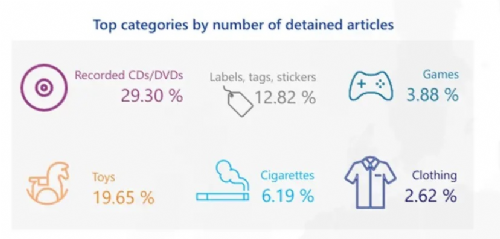 The figures cover both the EU external border and the internal market.
Recorded CDs/DVDs (including music and film releases, TV box sets, retro games and application software) were the most frequently detained counterfeit goods, accounting for nearly 30% of all seizures.
Toys accounted for almost one in five detentions while Labels, tags and stickers made up more than one in eight articles detained.
Within the internal market, Italy accounted for over 70% of all detentions, ahead of France (6.2%) and the Netherlands (4.8%).
Trade marks were the most frequently infringed rights among the detained goods (57%), followed by copyright (43%) and designs (7%).
At the EU border, Romania accounted for 43% of detained articles, followed by Bulgaria and Italy.
Spain represented more than half of the estimated value of counterfeit goods intercepted by value, followed by Germany.
The study shows how the growing volume of goods entering the EU, combined with fragmented supply chains, diverse transport methods and the expansion of e-commerce, is making counterfeit goods increasingly difficult to identify and intercept.
You can download the full document from the EUIPO website here.
Image taken from the EUIPO website.
Posted by: Blog Administrator @ 13.05Tags: Detentions, EUIPO, DG TAXUD, Customs,
Sharing on Social Media? Use the link below...Perm-A-Link: https://www.marques.org/blogs/class46?XID=BHA5489
Lewis Gaze Memorial Award winners 2026
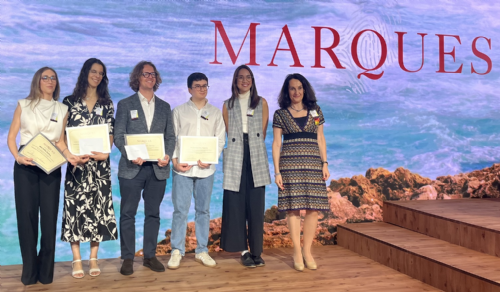 The winner of this year’s Lewis Gaze Memorial Scholarship was Marisa Fidalgo Frade. Her winning paper was titled: “Appropriate and proportionate remuneration to authors and artists: A legal analysis within the Portuguese legal framework”.
The Lewis Gaze Memorial Scholarship, established in 1997 as a memorial to the first Chairman and President of MARQUES, recognizes academic achievement.
Entries are invited from students attending university in the country hosting the MARQUES Annual Conference. This year, the students were from NOVA School of Law in Lisbon.
Second place was awarded to Francisco Lobão Alonso for his paper on “Repair-oriented interpretations in EU design law: Exploring exclusions and limitations”.
Third place was shared by Pedro Carrola Soares, who wrote a paper on “Morality and public policy in EU trademark law: Conceptual distinction and application in EU and Portuguese law”, and Ana Sofia Santos, whose paper was titled: “Pixels of protection: The quest to trademark AI-generated images in the EU”
All four students were presented with certificates during the Annual Conference by MARQUES Chair Claudia Pappas (pictured).
After the presentation, they took part in a short discussion about their work.
Marisa said her topic was chosen to appeal to a wide range of stakeholders, including rights management organisations. “The topic arose from my curiosity, professional as well as legal,” she said, adding: “My idea was to understand how remuneration is framed.”
Francisco described the issue of repairability and spare parts as “very contentious”, adding he looked to bring a new perspective: “I thought, how much can I stretch the legal interpretation to encompass a more welcoming mindset for enabling repairability for third parties to make spare parts, and to bring them more into the picture?” His paper reviews the history of design law and then analyses how the exclusions and limitations could apply if circularity is the main goal.
Pedro said his paper on morality and public policy in trade mark law grew out of “academic interest” in how the issue is approached in different European countries. He reviewed judgments from the EU General Court which assess “if a swear word is interpreted differently in another country, or, for example, if a name is interpreted in one way in Amsterdam and another way in Rome”.
Ana described her interest in AI-generated images as a “passion” saying: “I had a lot of fun with my examples. I had to learn about generative AI, which was also fun.”
Since September last year, Marisa has been working as in-house lawyer for a book publisher in Portugal. Francisco currently works as a lawyer at the law and advisory firm Passport Alliance, Pedro is working for an online gaming company and Ana is a contract manager at Airbus in Lisbon.
Amanda Costa Novaes of NOVA School of Law said the experience of holding the Lewis Gaze Award was “amazing”: “It’s very interesting to see the spark of the students and to see their interest in their topics, how they choose research and how they approach research.”
The School’s Masters programme in law, business and technology currently has 44 students and 15 researchers.
It wasn’t easy to choose the winner, said Amanda: “It showed we could be very proud of what we are doing and the level of research.”
Posted by: Blog Administrator @ 17.17Tags: Lewis Gaze, Lisbon, Annual Conference,
Sharing on Social Media? Use the link below...Perm-A-Link: https://www.marques.org/blogs/class46?XID=BHA5488
Ankara court rejects Turkpatent’s attempt to disown fee notice
|
Summary
|
Turkpatent cancelled a registration fee notice because of a power-of-attorney deficiency, then disowned its replacement after the applicant had complied. An Ankara IP court rejected the resulting attempt to apply the original deadline, placing legal certainty and reliance at the centre of the dispute. Yasemin Aktas reports
Turkpatent cancelled its initial registration fee notice because it had been served despite a deficiency in the representative’s power of attorney. It issued a replacement, refunded the earlier payment and received a second payment within the period running from service of the new notice. The office subsequently disowned the replacement as having been sent in error and removed the application.
The Ankara First Civil Court of Intellectual and Industrial Property Rights rejected that reversal in a judgment dated 16 July 2026. It annulled the decision of the Turkish Patent and Trademark Office’s Re-examination and Evaluation Board (YİDK) that had upheld removal of the application.
Cancellation of the first notice and reliance on its replacement
The initial registration fee notice was served on 16 January 2023. The judgment records that payment was made later than the 16 March deadline calculated by reference to that notice.
On 20 March, Turkpatent cancelled the initial notice on the basis that it had been served despite a deficiency in the power of attorney supporting the recorded representation. It issued a replacement notice, formally served on 28 March. The earlier payment was refunded. On 28 April, the applicant paid the fee again in full, within two months of service of the replacement.
On 8 May, Turkpatent stated that the second notice had been sent inadvertently and deemed the application lapsed. YİDK measured the second payment against the original notice, concluded that it fell outside the original two-month period and treated it as having no effect.
The office had to account for its intervening acts
Article 22 of Industrial Property Code No 6769, read with Article 12 of its implementing regulation, governs completion of registration and payment of the fee. The court acknowledged the two-month payment requirement. The dispute concerned which official notification could govern the applicant’s obligations after Turkpatent had cancelled the original notice, issued a replacement and received payment within the period running from its service.
The court held that applying the payment requirement also demanded clarity and reliability in administration, reflecting the rule-of-law principle in Article 2 of the Constitution. Turkpatent’s own intervening acts had to be given their legal effect.
Service of the second notice created a legitimate expectation that the office had corrected its earlier error and that a fresh two-month period had begun on 28 March. The applicant relied on that official direction and completed payment on 28 April.
The court held that the formally served notice retained legal effect until annulled, even if it had been issued defectively. When the applicant paid, it was acting on an official notice that the office had not yet disowned. The later claim of error could not justify removing the application in disregard of that reliance.
The reasoning placed responsibility for administrative records and personnel mistakes on the authority. In these circumstances, the office could not invoke its own record-keeping deficiencies, delays in recording representation changes or inadvertent acts to enforce a time limit extinguishing the applicant’s rights. The court treated the second notice as restarting the payment period and found the April payment timely.
Both the original and supplementary expert reports had supported Turkpatent’s position. The judge rejected their legal conclusion after examining the powers of attorney, chronology and office records. Measuring the payment solely against the January notice failed to account for its cancellation and the legal consequences of the replacement.
Why the claim of error did not defeat reliance
|
For anyone conducting trade mark proceedings before Turkpatent, the case illustrates the risk of an earlier decision or notice being revised on grounds of administrative error after an applicant has already acted on it. The judgment offers a basis for challenging comparable reversals, with the office’s intervening instructions and the applicant’s reliance placed at the centre of the analysis. |
Calling a notice an administrative mistake explains why the office wishes to change its position. It does not, by itself, determine what happens to an applicant who has already followed that notice. The court required those consequences to be assessed against legal certainty and good-faith reliance.
Turkpatent sought to enforce a deadline calculated from a notice it had cancelled, after directing the applicant to proceed under a replacement. The resulting risk was concrete: conduct consistent with the office’s current instructions was subsequently treated as insufficient to preserve the application.
For anyone conducting trade mark proceedings before Turkpatent, the case illustrates the risk of an earlier decision or notice being revised on grounds of administrative error after an applicant has already acted on it. The judgment offers a basis for challenging comparable reversals, with the office’s intervening instructions and the applicant’s reliance placed at the centre of the analysis.
Abion bore all the costs of this litigation because, in our assessment, the office’s contradictory handling of the application was arbitrary and the resulting injustice was clear. Our aim was to protect the client’s rights and demonstrate that judicial review can secure clarity and accountability in trademark proceedings in Türkiye.
What applicants should preserve when the office changes its position
Every version of a decision or notice should be retained, alongside proof of service, payment receipts and relevant representation and refund correspondence. The sequence can establish what the office instructed, when the applicant complied and whether the office changed its position only afterwards.
The ruling rests on a formally served replacement notice followed by payment within the period the court held it created. It provides no basis for assuming that every later communication restarts a deadline. The operative order annulled YİDK’s decision; it did not itself order registration. The judgment was issued at first instance with a right of appeal.
Official notices must carry legal consequences for the authority that issues them. An applicant who has complied with a formally served instruction should not lose its application merely because the office later labels that instruction an error.
Yasemin Aktas is Country Manager and Partner of Abion in Istanbul, Turkey and a member of the MARQUES Dispute Resolution Team. Abion acted for the successful party in this case.
Posted by: Blog Administrator @ 12.45
Tags: Turkey, Turkpatent, ,
Sharing on Social Media? Use the link below...Perm-A-Link: https://www.marques.org/blogs/class46?XID=BHA5487


