
Now in its twelfth year, Class 46 is dedicated to European trade mark law and practice. This weblog is written by a team of enthusiasts who want to spread the word and share their thoughts with others.
Click here subscribe for free.
Who we all are...
Talking MARQUES: 40th Annual Conference
 The latest episode of the Talking MARQUES podcast previews the 40th Annual Conference, which takes place in Lisbon, Portugal from 22 to 25 September 2026.
Three member of the MARQUES Programming Team take part in the podcast: Chair Claire Lehr of Edwin Coe LLP, Claus Eckhartt of Bardehle Pagenberg and Bahia Alyafi of Alyafi IP Group.
They mention some of the plenary sessions they are particularly looking forward to, and provide some insights into those they are taking part in themselves.
They also discuss the range of workshops available, some of the notable speakers at this year’s Annual Conference and a few of the social activities.
Finally, they highlight something that’s special about this year’s Annual Conference.
The podcast is recommended for anyone who has already registered for the Annual Conference and wants to find out more about the programme, as well as those who have yet to book their place.
You can listen to the podcast on the MARQUES website here and on Spotify.
So far, more than 840 people from 73 countries have registered for the Annual Conference and it is nearly sold out. If you have not yet booked your place, do so on the MARQUES website soon!
Posted by: Blog Administrator @ 10.19Tags: Annual Conference, Lisbon, Talking MARQUES,


 Sharing on Social Media? Use the link below...
Perm-A-Link: https://www.marques.org/blogs/class46?XID=BHA5468
Strong stance against trade mark squatting in Türkiye
Mutlu Yıldırım Köse and İrem Girenes Yücesoy report on a recent decision of the Turkish Patent and Trademark Office.
Trade mark squatting has unfortunately become increasingly common in Türkiye in recent years. Bad-faith applicants often identify trade marks that are registered and genuinely used abroad but have not yet been registered in Türkiye, file applications for those marks in their own names and then attempt to sell the registrations or present themselves as the rightful proprietors of the trade marks. In another common scenario, bad-faith applicants use the registrations they have unfairly obtained to prevent the real right owners from entering the Turkish market.
Fortunately, the Turkish Patent and Trademark Office continues to adopt a broad and rights-holder-friendly approach when assessing bad faith in oppositions filed against trade mark applications that are identical to distinctive trade marks registered and used abroad.
The absence of prior registration or use of a mark in Türkiye does not, by itself, prevent a finding of bad faith. In the oppositions filed against trade mark applications that are identical to a distinctive trade mark registered and used abroad and are of such a nature that it could not reasonably have been created coincidentally, the Office may accept bad faith even in the absence of any concrete evidence demonstrating the bad faith of the applicant, solely on the basis that the trade mark registered and used abroad has been copied identically.
 |
 |
| TM application 2025/043581 | Lala Berlin fashion brand |
Lala Berlin case
A very recent decision of the Office (E-71248886-130-260172511, dated 6 March 2026) confirms this approach. In this case, a trade mark application numbered 2025/043581 was filed before the Office for a mark that was identical, both in its word form and in its distinctive stylised form, to an originally created Berlin-based fashion brand.
Although the Lala Berlin trade mark enjoyed extensive international protection through registrations obtained in numerous countries and widespread use abroad, it had been neither registered nor used in Türkiye as of the date on which the dispute arose.
Apart from the fact that the trade mark application in question was an identical reproduction of the earlier trade mark, there was no additional evidence specifically demonstrating the applicant’s bad faith.
What was, however, beyond dispute was that the subject application is identical to the Lala Berlin trade mark and enjoyed protection through international trade mark registrations and extensive use in the apparel and fashion industry abroad.
In this respect, the opposition relied not only on the genuine right ownership on the trade mark but also on the fact that the application constitutes a deliberate reproduction of the trade mark registered and used abroad, extending from the identical word element to its stylisation and positioning.
It was argued that the filing of such an application for use in the very same field of business cannot reasonably be regarded as an act undertaken in good faith. It was further emphasised that, given the limitless freedom available in selecting a trade mark, the adoption of the identical wording and an identical overall composition can hardly be explained as a mere coincidence.
Following its examination under Article 6/9 of the Industrial Property Code no 6769, the Trademarks Directorate of the Office concluded that the applicant had "failed to act in accordance with the principles of honest commercial practices with the intention of knowingly obtaining an unfair advantage" and accordingly rejected the application in its entirety on the grounds of bad faith.
Clear and consistent approach
This decision demonstrates that the Office has adopted a clear and consistent approach in assessing bad faith in trade mark applications seeking to identically reproduce trade marks that are registered and used abroad but have not yet been registered or used in Türkiye.
Accordingly, whether or not a trade mark is registered in Türkiye, it is essential to monitor foreign trade mark portfolios, regularly review the Turkish Trademark Bulletin and file an opposition particularly on the ground of bad faith when an identical trade mark application is identified.
Otherwise, once such bad-faith applications proceed to registration, the rightful owner will be required to seek their invalidation through court proceedings before entering the Turkish market.
Mutlu Yıldırım Köse is a partner and İrem Girenes Yücesoy is a managing associate with Gün+ Partners in Turkey. Mutlu is a member of the MARQUES Cyberspace Team and İrem is a member of the Anti-Counterfeiting and Parallel Trade Team. The authors represented Copenhagen Studios GmbH, the owner of the Lala Berlin trade mark, in the opposition proceedings discussed in this article
Posted by: Blog Administrator @ 14.24Tags: Türkiye, Lala Berlin, squatting, opposition,
Sharing on Social Media? Use the link below...Perm-A-Link: https://www.marques.org/blogs/class46?XID=BHA5467
WIPO report reveals record investment in intangible assets
 Investment in intangible assets passed $10 trillion for the first time in 2025, according to the third edition of the World Intangible Investment Highlights, published by WIPO and Italy’s Luiss Business School (LBS).
According to the report, intangible investment grew 5.5% from 2020 to 2025, compared with 3.2% for tangible investment, and now accounts for nearly 13% of GDP across the 29 economies covered.
Investment trends
The 29 high- and middle-income economies represent about 57% of world GDP. The latest edition of the report adds estimates for Canada and the Philippines and updates the figures for Brazil, India and Japan.
Companies and government entities in the US invested nearly $5 trillion in intangibles in 2025. Those in Japan invested $810 billion (an increase of 4.8%) and those in Germany $695 billion.
The gap between the US and the next four economies combined has roughly doubled over the past decade.
In India and the Philippines, intangible investment grew 5.3% and 3.9% annually over the past decade respectively, demonstrating that intangible investment is growing beyond high-income countries.
In a statement, WIPO Director General Daren Tang said: “This record-breaking rise in intangible asset investment clearly shows that global economic value is shifting from physical assets to intangible assets. This cuts across both mature and emerging economies. This data shows that countries and businesses are increasingly turning to innovation, technology and creativity to drive growth. I hope that the report gives decision makers insights into these trends and help them put in place the right policies, practices and programs to support their innovators and creators.”
The report is produced under the WIPO–LBS Partnership on Intangible Assets in the Global Economy and was published during the WIPO General Assemblies in Geneva. A summary and video presenting the main findings can be viewed on WIPO’s website here.
WIPO-NGO Stakeholder Dialogue
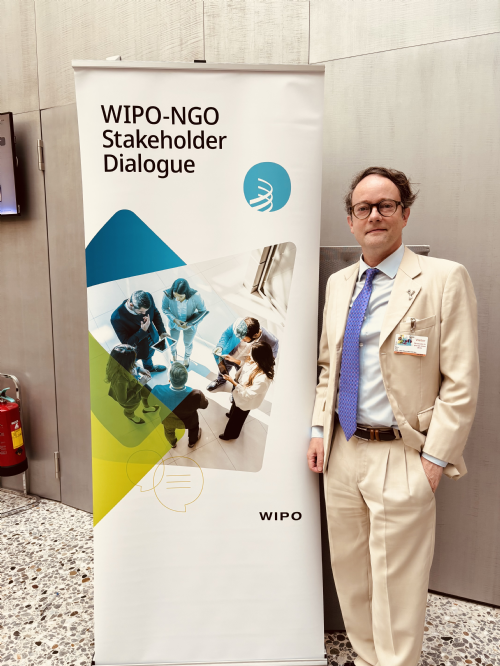
MARQUES participated in the WIPO-NGO Stakeholder Dialogue that took place in Geneva on 10 July 2026, represented by MARQUES 2nd Vice-Chair Tapio Blanc of F. Hoffmann-La Roche AG.
WIPO organised the WIPO-NGO Stakeholder Dialogue in the margin of the General Assemblies. It included 49 stakeholder participants from different areas and from all over the world. After the opening remarks by Director General Daren Tang, the meeting included a presentation by Assistant Director General Marco Aleman on the topic “IP & Innovation Ecosystems Sector” and a lively Q&A session.
Tapio said: “This was a very productive meeting and a great opportunity to discuss current issues of interest to MARQUES members directly with WIPO officials. We look forward to continuing to work closely with WIPO on various projects over the coming year and even to strengthening our collaboration."
The 68th Series of meetings of the Assemblies were held from 7 to 15 July. More details are available on WIPO’s website here.
Photo of Tapio Blanc at the WIPO-NGO Stakeholder Dialogue
Posted by: Blog Administrator @ 08.29Tags: WIPO, LBS, Intangible Investment, Tapio Blanc,
Sharing on Social Media? Use the link below...Perm-A-Link: https://www.marques.org/blogs/class46?XID=BHA5466
Record filings at EUIPO
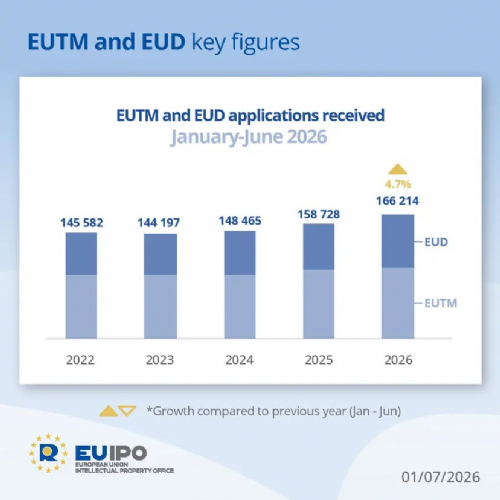 There were 166,214 EU trade mark (EUTM) and EU design (EUD) applications during the first half of 2026, an increase of 4.7% on the same period in 2025.
The number of EUTM applications grew 8.4% to 104,263, surpassing the previous record set in 2021.
Filings from EU Member States grew by 14.6%, leading to the share of applications coming from the EU going up from 57.4% in 2025 to 60.7% in 2026.
The highest growth came from France (17.4%) followed by Germany (15.2%) and Poland (13.3%).
Filings from China fell 12.4% but the country remains the highest filer overall.
Meanwhile, there were 61,951 EUD applications during the half-year period, a decline of 1% compared to 2025.
Despite the overall decline in EUD applications, filings from EU Member States grew by 1.6%, led by growth in Spain (up 28%).
The first half of 2026 also saw the first applications for EU craft and industrial geographical indications (CIGIs).
Of the 81 CIGC applications filed so far, 42 have come from Portugal, 25 from France and 10 from Slovakia.
Read more about the half-year trends on the EUIPO website here, which includes charts including the one pictured above
Posted by: Blog Administrator @ 14.40Tags: EUIPO, EUTM, EUD, REUD,
Sharing on Social Media? Use the link below...Perm-A-Link: https://www.marques.org/blogs/class46?XID=BHA5465
Personalisation pitfalls in the age of AI - part 2
In the first part of this article, Marion Heathcote, Chair of the MARQUES IP Emerging Issues Team, noted that the Team asked: if AI understands us better than we understand ourselves, why not let it handle our purchasing decisions entirely? What would this mean for trade mark law?
To answer those questions, we are reproducing the Team’s original 2022 draft article, penned by Michal Hasiow, on ‘Navigating the pitfalls of brand control in product and packaging personalisation’.
The previously published part 1 introduced the concept. In this second part, we look at how brands can retain (or regain) control.
Boundaries and safe words
| "Too much filtering can stifle creativity, while too little allows harmful content to slip through. Finding the right balance is essential to mitigate the risk of brand damage." |
While brands’ trust vis-a-vis their customers can lead to a richer customer experience, it should have its limits. Personalisation options can be kept in check by offering a curated catalogue of choices – allowing consumers to select from a predefined set of features. This approach, focusing on design elements such as colours, shapes or ribbons, significantly reduces risks. However, some combinations (such as national flag colours) may still spark controversy, depending on the context.
Allowing predefined texts, such as initials or short phrases, is generally low risk. But while these options seem safe, they still leave room for problematic combinations, such as “SS” or “KGB”. The real challenge arises with freely generated content, such as longer text or photos, which are harder to control and carry higher risks.
Automated filtering systems help screen inappropriate terms, but they come with technical limitations. Too much filtering can stifle creativity, while too little allows harmful content to slip through. Finding the right balance is essential to mitigate the risk of brand damage.
For instance, a customer from a major beverage brand would receive the following message when using their personalisation service:
“Oops! Looks like the name you requested is not an approved one. Names may not be approved if they're potentially offensive to other people, trademarked, or celebrity names. We've worked hard to get this list right, but sometimes we mess up. If you think this is an error, please contact our Customer Care team. Otherwise, please try again, keep it fun and in the spirit of sharing!”
The list includes ‘Hitler’ and ‘Stalin,’ but not ‘Mussolini’ or ‘Bin Laden’. Many sexist and racist terms are banned in English but may not be filtered in other languages, such as their Spanish equivalents. This raises the issue of how multinational brands can handle personalisation across different cultures with varying standards for offensive content.
And what about words that don't fit neatly into defined categories but could still be harmful, particularly if they express brand criticism? A famous footwear brand learned this lesson early in the personalisation era. When the brand refused a personalisation request based on a term “sweatshop”, the refusal sparked viral backlash. The ensuing controversy surrounding the brand’s decision to deny the request, along with the customer service exchanges, ended up damaging the brand’s reputation and compromising the entire personalisation service.
This highlights the delicate balance brands must strike: while controlling associations is important, refusal to personalise based on subjective reasoning can lead to accusations of censorship, as another tech company experienced when it blocked references to political speech in its engraving service.
These situations can easily escalate, proving that what seems like a harmless term may, in fact, have far-reaching consequences.
Terms and conditions
Being upfront about the terms and conditions for personalisation may not completely eliminate misuse, but it serves the important purpose of clarifying the brand owner’s intentions, which can be crucial if issues arise. These terms should include:
- the consumer warrants that they have the necessary permissions to place the personalisation order and authorise the operator to produce the item(s) on their behalf;
- the consumer is solely responsible for the submitted content and assumes all liability for any misuse or legal consequences;
- the consumer warrants that the submitted content does not infringe third-party rights, including copyright, trade mark, right of publicity or privacy, and will not libel or defame any third party;
- the operator reserves the right to refuse any content deemed offensive, inappropriate or explicit, with full discretion, and without obligation to provide an explanation.
In-store personalisation
| "By guiding the personalisation process in person, brands can ensure a more positive experience, keeping it fun and engaging, rather than risking the creation of controversial or damaging products – such as a dictator’s face on a box of morning cereals." |
One idea for brand owners to consider is to shift personalisation to the in-store experience, whenever possible. This approach allows the process to be more directly managed by personnel, offering a level of control that online platforms can't always provide.
In-store personalisation helps guard against the unpredictable "imaginativeness" that often accompanies anonymous online ordering, where the lack of direct oversight can lead to unintended or inappropriate content.
By guiding the personalisation process in person, brands can ensure a more positive experience, keeping it fun and engaging, rather than risking the creation of controversial or damaging products – such as a dictator’s face on a box of morning cereals. This extra step not only protects the brand but also ensures that customers enjoy a more tailored and controlled interaction with the brand.
Marion Heathcote is a Principal with Davies Collison Cave in Syndey, Australia and Chair of the MARQUES IP Emerging Issues Team
Posted by: Blog Administrator @ 09.52Tags: personalisation, IPEI, AI,
Sharing on Social Media? Use the link below...Perm-A-Link: https://www.marques.org/blogs/class46?XID=BHA5464
Personalisation pitfalls in the age of AI - part 1
In 2022, the MARQUES IP Emerging Issues (IPEI) Team prepared an article on brand control in product and packaging personalisation through user-generated content. This article was never published. What seemed like an emerging issue at the time has resurfaced as the Team revisited the very concept of defining an "emerging issue”, just when the world outside the IP realm felt more unpredictable than ever, as Team Chair Marion Heathcote explains.
AI and large language models are reshaping industries and legal frameworks at an unprecedented pace, and intellectual property is no exception. As a result, even articles written just a few years – or even months – ago now demand a fresh look to ask: "Does this still hold true today?"
Instead of updating the original text, on review the current IPEI Team wanted to publish Michal Hasiow’s original text as it was first drafted, thus allowing the extent of change to speak for itself while leaving space for alternative interpretations.
AI and personalisation
| "What if technology could go even further – shifting brand personalisation away from user-generated content and toward dynamic trade marks?" |
At first glance, AI seems to offer a perfect solution for personalisation challenges. It can automate content moderation, filter harmful language and deliver dynamic customer experiences with ease. By processing vast amounts of data and responding to customer inputs in real time, AI enables seamless, adaptive personalisation.
Yet, while AI enhances efficiency, it also introduces new challenges. Automated systems are far from flawless, and the risk of over- or under-filtering remains, particularly when navigating different languages and cultural nuances. AI also raises ethical concerns of potential biases, while the opacity of its decision-making process complicates accountability. Ironically, the very tools designed to prevent misuse may create unforeseen problems for brands. A “hybrid approach” that blends AI with human oversight seems crucial for managing these risks, ensuring personalisation remains both effective and ethically responsible.
But what if technology could go even further – shifting brand personalisation away from user-generated content and toward dynamic trade marks? In this model, brand owners, not consumers, would retain control, personalising branding in real-time based on consumer behaviour, preferences and contextual data.
Logos would adapt, dynamically changing colour, thickness, placement, patterns and motion effects in response to a person’s age, gender, shopping habits, fitness data or location. Instead of users crafting their own versions, brands, powered by AI, would handle the personalisation – offering a seamless yet controlled experience.
After all, if AI understands us better than we understand ourselves, why not let it handle our purchasing decisions entirely? But what would this mean for trade mark law?
Navigating the pitfalls of brand control in product and packaging personalisation – the 2022 edition
“In my own market research for dozens of Fortune 500 companies, I have found that the best way to communicate authenticity is to trigger personalization. Do audience members see themselves in the slogan… and therefore in the product? Unfortunately, achieving personalization is by no means easy” (Words That Work: It's Not What You Say, It's What People Hear by Frank Luntz)
Brands are increasingly allowing consumers to personalise their products and packaging, reflecting a growing consumer demand – especially among millennials and Gen-Z – for tailored experiences. According to a 2019 Deloitte study, this shift is part of "The rise of mass personalization”, while Bain's research highlights how customisation can boost sales, enhance loyalty, and help brands better target specific consumer segments.
| "Even short-lived products such as personalised cereal boxes or marmalade jars can be shared widely, sometimes reaching millions, with brands’ active encouragement." |
However, as the benefits are clear, the risks are equally significant. Personalisation through user-generated content often means relinquishing some degree of control over a brand’s identity. Allowing consumers to tinker with the brand’s image opens the door to unforeseen consequences, including the potential for offensive or damaging content. For brands, this underscores the importance of defining boundaries upfront – perhaps through a well-crafted personalisation policy – to help mitigate these risks while still offering the appeal of customisation.
Say it with a sneaker and say it loud!
Personalisation aims to enhance consumers’ sense of uniqueness and individuality. However, a product designed “just for you” is often shared with others. Thanks to social media, even short-lived products such as personalised cereal boxes or marmalade jars can be shared widely, sometimes reaching millions, with brands’ active encouragement.
While a customer's choice of mismatched colours for sneakers may cost them a few followers, it generally won’t harm the brand. But what about a photo of the same sneakers with a racist term embroidered on them, posted and shared thousands of times? Or what if a consumer adds a competitor’s logo to an already branded product?
These scenarios are a nightmare for IP counsel, as they can’t always be addressed through traditional enforcement or communication methods. With customers having the power to shape brand narratives, how can brands regain control once it’s been loosened?
Find out more in the second part of this article, available soon.
Posted by: Blog Administrator @ 09.05Tags: IPEI, AI, personalisation, UGC,
Sharing on Social Media? Use the link below...Perm-A-Link: https://www.marques.org/blogs/class46?XID=BHA5463
Turkish court rules in favour of video game trade mark
 Most IP practitioners would probably answer "yes" if asked whether the title of a successful video game can function as a trade mark. However, can a relatively commonplace word, forming part of a fictional city within a video game, become so strongly associated with a single publisher through decades of use that it deserves trade mark protection in its own right?
A recent final decision of a Turkish Intellectual Property Court suggests that, under the right circumstances, the answer may also be yes. Yasemin Aktas explains.
The judgment is remarkable for several reasons. It recognised trade mark protection for a relatively commonplace word forming part of a fictional city despite the absence of an earlier national registration for that word.
Equally noteworthy is the procedural history of the case. The Court rendered its judgment at the first hearing, without appointing an expert panel, and the decision became final within approximately five months – an unusually swift outcome for Turkish trade mark invalidation proceedings.
Video games create brands, not just products
Unlike many traditional consumer products, successful video games rarely remain just software. They evolve into entertainment ecosystems.
Players do not simply remember the title of a game. They remember its fictional cities, characters, atmosphere, visual identity and stories. Over time, these elements become inseparable from the publisher behind them.
For that reason, fictional locations often acquire considerable commercial value. Consumers encountering those names may immediately think of a particular game franchise, even where the publisher's name is nowhere to be found.
This presents an interesting challenge for trade mark law. Protection may no longer be confined to the complete game title. Through long-standing and intensive use, individual elements within that title may themselves begin to function as indicators of commercial origin.
A fictional city – and one word within it
The recent Turkish judgment provides an interesting illustration of this evolution.
The dispute concerned a trade mark incorporating the dominant element of a fictional city appearing in a globally successful video game franchise. Rather than relying on an earlier Turkish registration for that dominant word, the claimant argued that more than 20 years of worldwide use had fundamentally changed how consumers perceived it.
The Court accepted that argument. After reviewing extensive documentary evidence, it concluded that the disputed word had acquired distinctiveness through continuous worldwide use and had become closely associated with a single commercial source.
It further found that the defendant had sought to capitalise on that reputation by adopting both the dominant verbal element and visual features recalling the claimant's game.
The procedural handling of the case is equally striking. Instead of referring the dispute to a court-appointed expert panel – as is commonly seen in Turkish trade mark litigation – the Court considered the documentary evidence sufficiently compelling to resolve the dispute itself.
Judgment was therefore rendered at the first hearing, and the decision became final only a few months later.
Acquired distinctiveness is ultimately about consumer perception
The most significant aspect of the judgment is not that it protects a fictional city.
It is that the Court recognised that one element of that fictional city name had, through decades of use, acquired an independent trade mark significance.
Standing alone, the word was neither invented nor particularly distinctive by nature. Yet continuous commercial use had gradually transformed the way consumers perceived it.
Rather than understanding it merely as an ordinary word, consumers had come to recognise it as identifying a particular fictional universe – and, ultimately, a particular publisher.
This is precisely what acquired distinctiveness seeks to protect. It is not the word itself that changes, but the perception of the relevant public.
| "The decision demonstrates that, in appropriate circumstances, Turkish courts are prepared to look beyond formal registrations and consider the broader commercial context in which consumer recognition has developed." |
The judgment therefore reminds us that distinctiveness is dynamic rather than static. It can be created through years of investment, commercial success and consistent consumer exposure.
Looking beyond the register
Another interesting aspect of the judgment is the Court's emphasis on genuine ownership.
Rather than limiting its analysis to registration certificates, it examined who had actually created, developed and commercially exploited the fictional world over many years.
This approach reflects the realities of the gaming industry.
Modern game publishers invest enormous resources in building fictional universes through advertising, merchandising, licensing, streaming platforms, esports, online communities and social media. Those investments often generate recognition extending well beyond what appears on the trade mark register.
The decision demonstrates that, in appropriate circumstances, Turkish courts are prepared to look beyond formal registrations and consider the broader commercial context in which consumer recognition has developed.
Practical takeaways
The judgment should not be interpreted as reducing the importance of trade mark registration. A comprehensive trade mark portfolio remains the strongest and most predictable form of protection.
It does, however, highlight the evidential value of continuous use. Historical advertisements, archived websites, gameplay footage, press coverage and social media activity may ultimately prove decisive in demonstrating how consumers perceive a particular sign.
Equally, businesses should exercise caution when adopting names inspired by successful entertainment properties. Simply adding descriptive expressions such as Gaming, Studio or Interactive may not sufficiently distance a later sign where consumers continue to recognise its dominant element.
Trade mark principles adapt to market reality
The importance of this judgment lies not in recognising that a video game title can function as a trade mark – few practitioners would dispute that proposition.
Its real contribution is more subtle.
It demonstrates that, under the right circumstances, decades of continuous use may transform a relatively commonplace word into a distinctive source identifier deserving trade mark protection in its own right.
More broadly, it reminds us that trade mark law is ultimately concerned with consumer perception. Where consumers no longer perceive a word in its ordinary sense but instead recognise it as identifying a single commercial source, the law may be prepared to protect that association – even where it has been built around a fictional world.
As fictional universes continue to evolve into some of the gaming industry's most valuable commercial assets, decisions such as this illustrate how traditional trade mark principles are adapting to the realities of modern entertainment brands.
Yasemin Aktas is a Partner of ABION in Istanbul and a member of the MARQUES Dispute Resolution Team. She represented the plaintiff in the case discussed
Posted by: Blog Administrator @ 11.34Tags: video game, Turkey, acquired distinctiveness ,
Sharing on Social Media? Use the link below...Perm-A-Link: https://www.marques.org/blogs/class46?XID=BHA5462


